THE INTEGRATION
WORKSHEET
REINFORCEMENT
THE INTEGRATION
reinforcement WORKSHEET

This worksheet is here to help you reinforce the somatic skills and exercises we learned during THE INTEGRATION experiential group. Please remember to practice at the pace that feels right for you.
Slides are available at the bottom of the page.
“Awareness reveals the adaption, and that creates agency.”
As you practice, remember that learning happens through repetition, not perfection.
These skills are often easiest to strengthen when your stress levels are low, allowing your nervous system to build familiarity before needing them during more challenging moments.
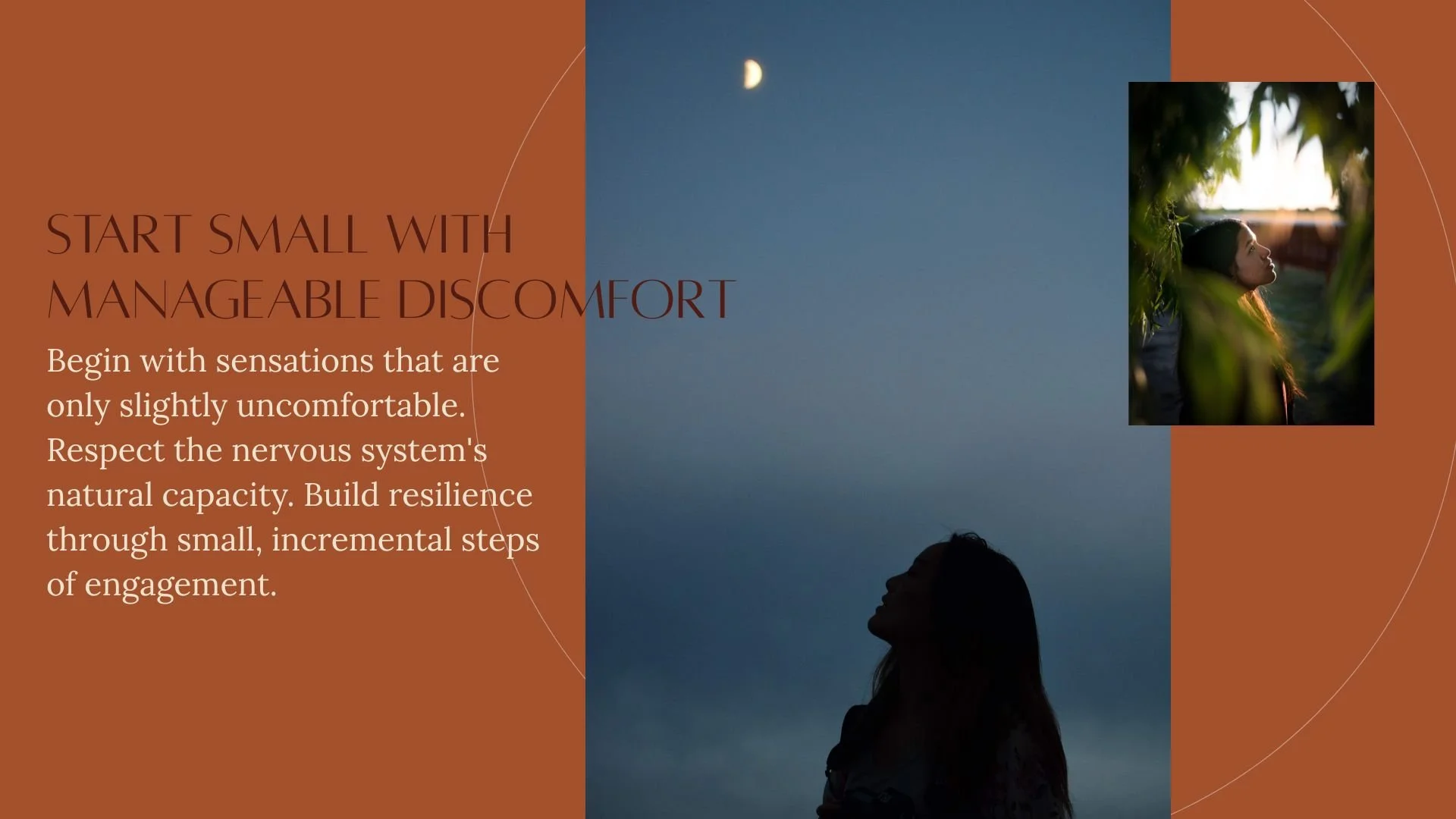
Move at the pace of safety, trusting that your nervous system can only integrate a little at a time.
You may notice that practicing feels awkward, mentally effortful, or even frustrating at first. This isn't a sign that you're doing it wrong, it's often a sign that your brain is building new neural pathways and your nervous system is learning a new way of responding.
Welcome the tension with curiosity, honor your capacity, and trust that small, consistent practice creates lasting change.
Something to Work With
Many of the exercises in this workbook ask you to bring a little bit of real tension or discomfort into the room, on purpose, so there's something to actually practice with. Rather than searching for that in the moment, it helps to have a small list ready ahead of time. You don't need to go deep here, or pick your hardest material. The goal is something mild enough to stay well within your capacity, just enough to feel real.
A few places to draw from:
Physical or postural, the easiest to control
Holding your arms overhead, a mild stretch, sitting unusually straight, a brief breath hold, clenching a fist or jaw.
Memory based
A minor annoyance from this week, or one of the low or moderate stress incidents you've already identified.
Anticipatory
Something mildly dreaded on this week's calendar.
Imagery based
A generic mildly frustrating scenario, traffic, a slow computer.
Interpersonal, imagined
Picturing yourself saying no to a small to medium request.
Keep one or two of these in mind as you move through the workbook. Now, let's start where every session does, with tapping into support and resource.
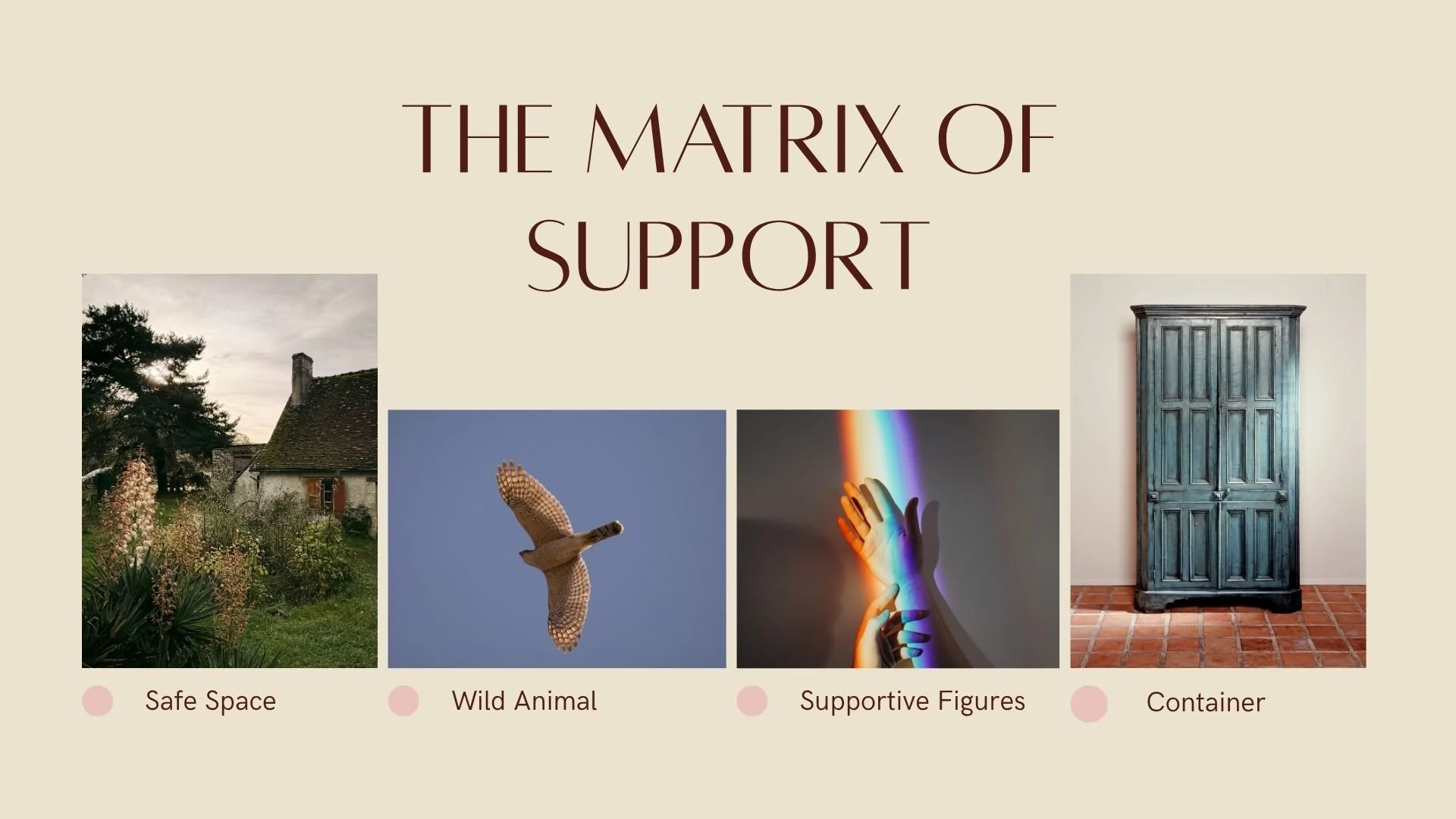
Matrix of Support
Safe Place
Before you can work with anything difficult, your nervous system needs a place it already recognizes as safe, somewhere it can return to any time the work asks too much. Build an internal sanctuary for you, real or imagined. Build it with as much detail as you can, what you see, hear, smell, and feel. The more vivid the image, the more it tends to land, since your nervous system responds to rich sensory detail the way it responds to something actually happening. This is where you can come to take a mental break, or even where you can invite younger parts of you to stay safe, while you engage in adult, self led energy.
Supportive Figures
Part of what regulates a nervous system is the felt sense of not being alone. A supportive figure gives your body that experience internally, even when no one else is actually in the room. Bring to mind someone or something, real, imagined, or symbolic. It should provide a felt sense of being accompanied and supported. Find three supportive figures, one that represents wisdom, another for nurturance, and another for protection, so you have a different kind of support available depending on what a given moment calls for.
Wild Animal
Some parts of the nervous system, especially fight, flight, and shutdown, respond better to instinct than to reasoning. A wild animal ally gives you access to that instinctual, protective energy directly, without shame attached to it. This is especially useful later, when working with fight or flight responses. Wild animals are responsive and protective, and they carry no shame about tapping into a stress response of fight, flight, or shutdown when it's needed. Wild does not mean feral. A wild animal stays in rhythm with its environment and its own needs. A feral animal has lost that rhythm. The animal you choose as an ally should reflect the wild, not the feral.
Container
Not everything that surfaces needs to be processed the moment it appears. A container gives you a way to acknowledge something without being flooded by it right now. This is an imagined place to set down anything that feels like too much in this moment. You're not discarding it, only setting it down for later. The container should have a door or lid, as well as a lock, and your name on it, so it's clearly yours and clearly secure. Some examples are a chest, an armoire, a jewelry box, or a locker. This is practicing healthy compartmentalization, on purpose, and with full choice, rather than the kind that happens automatically and without your consent.
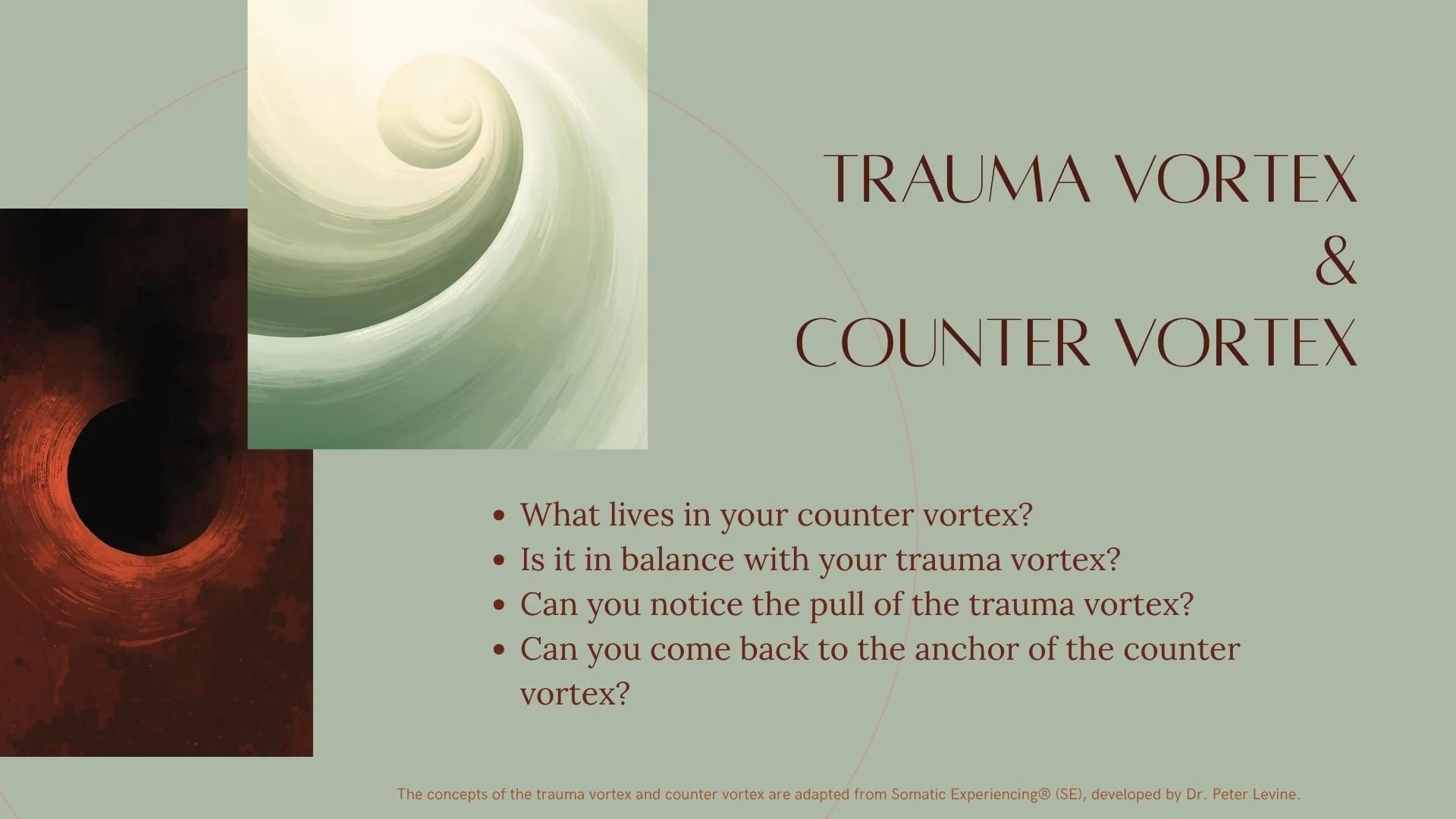
Trauma Vortex & Counter Vortex
Find your counter vortex first
In alignment with building a container of support I recommend building your counter vortex first. It may even be helpful to take inventory of what is in your counter vortex. Happy memories, the matrix of support, glimmers, safety, feeling authentic, safety, rest and calm, as well as flow are all found there. As we explore the trauma vortex stay curious if there is a balance between both, if the trauma vortex is larger, consider reinforcing your counter vortex with additional memories, resources, values or even coping skills that land for you.
Next let us explore the trauma vortex. The trauma vortex is where chaos, stress, pain, survival and disconnection live. Life cannot exist without a trauma vortex. We are not aiming to get rid of it at any point. It is normal and healthy for life to pull us in and out of these two vortices. What we aim to do is familiarize ourselves with what it feels like to move in and out of these and what can support the balance between both, in size and back and forth movement. Consider your counter vortex like an anchor you can come back to, life will pull you into the trauma vortex, but can you find your way back to your anchor of steadiness and safety, even if it’s just for a moment. This supports flexibility and responsiveness.
Get to know your trauma vortex
Bring to mind a bad day, where multiple things went wrong. Revisit your list of content above as needed. Can you notice what it felt like when you first started to notice things were not going your way? Maybe you even recall the first thing that went wrong. Or maybe you’re revisiting this worksheet now, while you’re having a bad day. What does it feel like to be in the wider part of the funnel, the top of the trauma vortex, the entrance, where it is often easier to leave? You may want to write down what you remember or notice now. Next explore what does it feel like at its depths where it is at its most intense? It may be much harder to take breaks from the counter vortex here. We may need something that lands more deeply, like holding ice cubes, a tight hug, going for a more intense workout. It would also be understandable if moving towards taking action to take a break feels inaccessible. This is where easier smaller shifts can still land; one deep breath, looking out a window, offering a soft hand to your chest. Again, it is about showing yourself, you can take breaks from this, even if just for a short moment to only slightly lessen the intensity. Even a reduction in intensity of 1% is a break and that matters to your nervous system. As you familiarize yourself with what it feels like to be in the trauma vortex, you may be able to begin to notice what is pulling you to the trauma vortex and can start offering yourself support sooner to maybe even avoid a visit to the trauma vortex all together or a visit of less intensity.
The concepts of the trauma vortex and counter vortex are adapted from Somatic Experiencing® (SE), developed by Dr. Peter Levine.
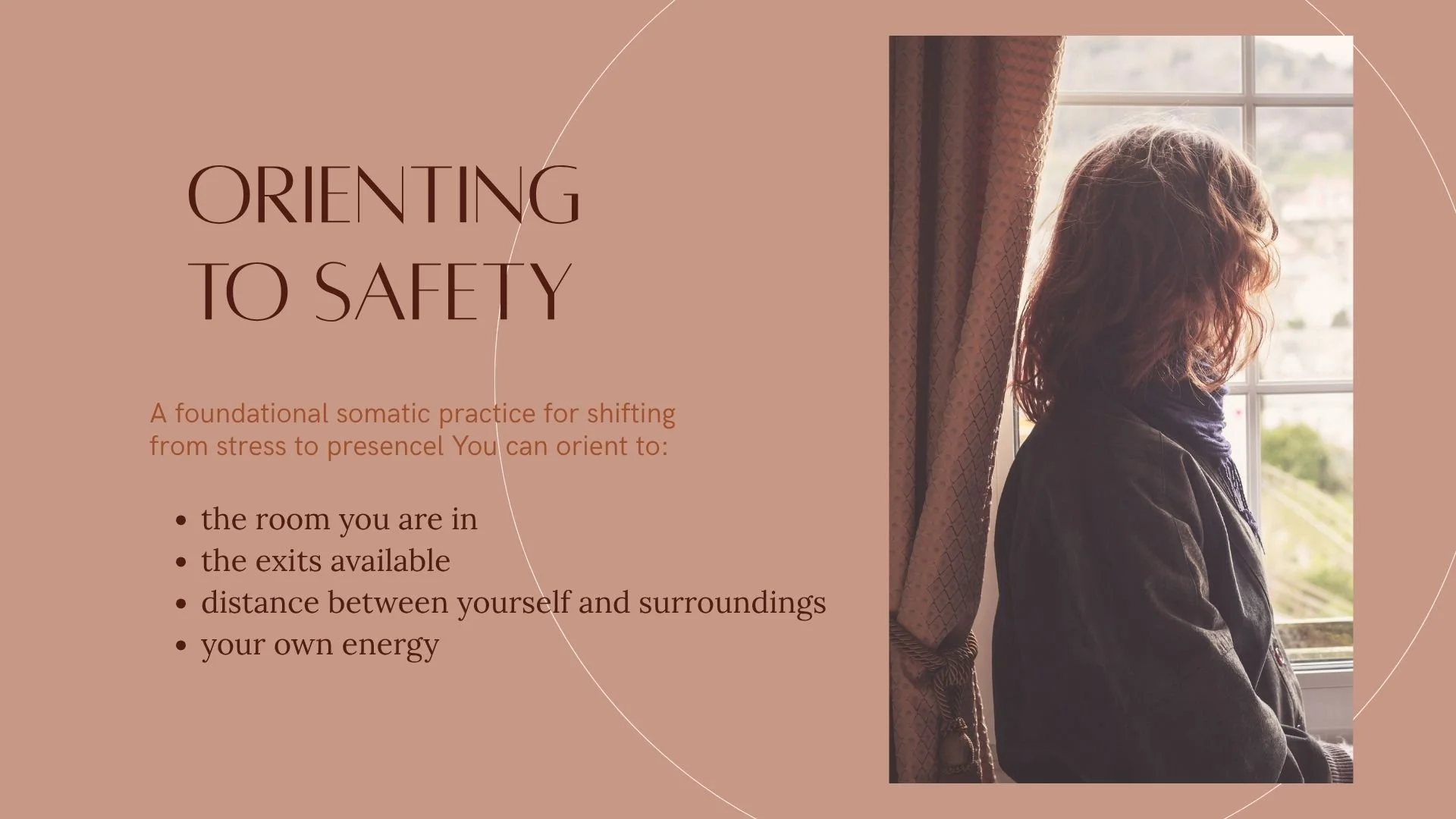
Moving Awareness
Room Orientation
Orienting is one of the fastest ways to signal safety to the nervous system. When the eyes and neck actively scan the environment, the brain registers that you are checking your surroundings, which is itself a cue that no immediate threat requires stillness or hiding. It's also a skill you can use anywhere, with no equipment and no one needing to know you're doing it. Let your eyes move slowly around the room, unhurried, like you're taking it in for the first time. Let your neck turn along with your eyes rather than moving your eyes alone. Name a few things you notice that feel neutral, positive or steady. If you need ideas on how to find neutrality in the room try noticing colors, textures, patterns, shapes, shadows, or even light. You can simplify this and become more directive with yourself or someone else, if experiencing high stress or even panic, “find five squares… look at the green in your shirt… look at your hands, now look at my face, now look at the pillow you’re holding.”
Distance Orientation
Sensing the actual physical space around you helps counter the felt sense of collapse or closing in that often accompanies activation. It gives the nervous system real spatial information instead of the distorted sense that everything is too close or too small. Without moving from your seat, let your attention travel outward toward the nearest wall, then the farthest one. Notice the actual distance as best you can sense it. You can even extend an arm toward a wall and gesture how far that distance really is.
Exit Orientation
Locating an exit is a primal safety check. Even when you have no intention of using it, simply knowing it's there satisfies a very old part of the nervous system that's always asking whether escape is possible if needed. Answering that question, even just visually, frees up energy that was otherwise on standby. Look around the room and find the door, window or any other way out. Let your eyes rest there for a moment and notice if anything in your body shifts, such as a breath releasing or your shoulders dropping, once that question has been quietly answered.
Energetic Space
Many people carry a habitual sense of taking up less space than they actually do, a kind of energetic contraction that often mirrors emotional or relational patterns of shrinking. Noticing this, and gently inviting expansion, practices occupying space as a felt experience rather than just an idea. Close your eyes or soften your gaze and ask yourself how much space you feel like you're taking up right now, inside your own body. Then, without forcing it, invite that felt sense of space to expand just slightly. Not a dramatic shift, just a small, permitted widening.
Eye Exercise
The eyes have a direct line to the nervous system, and certain eye movements and fixations are associated with shifting out of sympathetic activation and into a more settled, parasympathetic state. It's a subtle, low effort tool, which makes it easy to use discreetly, anywhere. Disclaimer, please enter these exercises gently if you have a history of traumatic brain injuries or concussions.
You can try to first keep your face and eyes fixed in front of you, but invite yourself to see how much you can notice out of the corner of your eyes. This is engaging your peripheral vision, which is the opposite of tunnel vision; what naturally happens to our vision in a state of stress.
If you are able to tolerate this, move on gently with keeping your face fixed in the forward position and stretching your eyes to look to the left, slightly at first and then as far to the left as you can or prefer, stay here for 5 - 30 seconds, whatever feels good for you. Then move your eyes to the right to even out the stretch on the other side, only if it is tolerated well. Stay here for 5 - 30 seconds, whatever feels good.
You may want to stop there, see how you feel, and if no dizziness or discomfort, you can proceed.
Next try to look up to the upper left corner of the room, while keeping your face fixed forward, again stay for the time that feels supportive, approximately 5 - 30 seconds. Then look to the bottom left corner of the room for 5 - 30 seconds or as tolerated. Repeat on the right side, following the same pattern. You can stay 5 - 30 seconds with each eye position; first upper right, then lower right.
You can then bring your hands down while keeping your eyelids closed. If it feels good, you can continue to stretch your eyes by drawing circles behind your closed eyelids in one direction and then the other. You can then end the exercise with warming up your hands, bringing your palms to your closed eyelids, and offer soothing pressure or movement that feels good for you.
Tracking
SIBAM
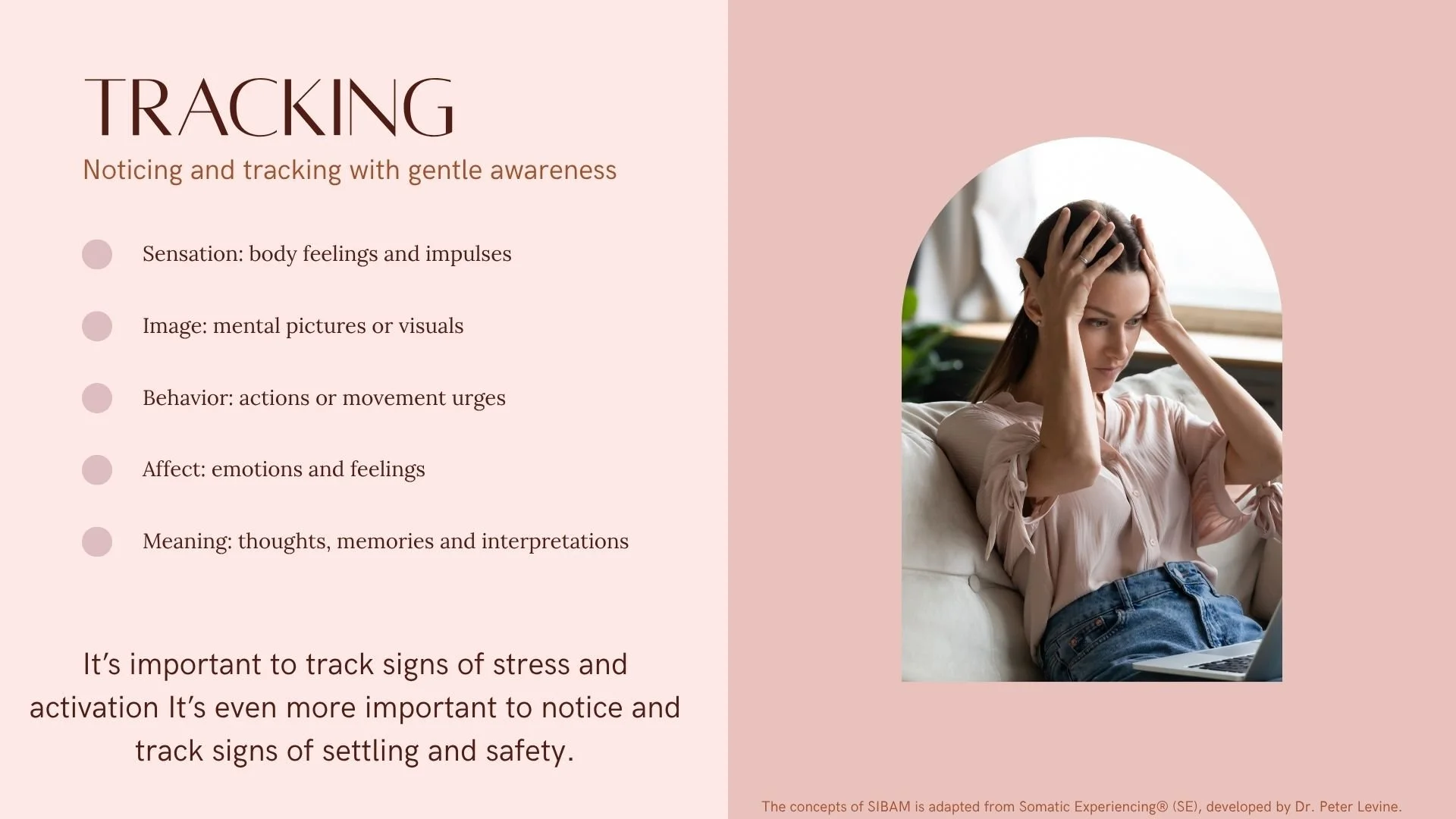
SIBAM is a framework developed in Somatic Experiencing® that helps people notice and track experience through five channels of information. Trauma can narrow or disconnect these channels; practicing SIBAM helps integrate them so we can process experiences with greater flexibility.
Sensation: What do I physically feel in my body?
Sensations are the direct physiological experiences occurring in the body. They are neither good nor bad, they're simply information.
Questions to ask:
What do you notice in your body right now?
Where do you notice it?
Is it moving or still?
Does it have a temperature, shape, size, or texture?
Image: What pictures, symbols, colors, or memories come to mind?
Images are the visual representations that naturally arise. They don't have to be literal or accurate; they're just another way the nervous system communicates.
Questions to ask:
If this sensation had an image, what would it be?
Do any colors, symbols, or scenes come to mind?
Does your body remind you of anything?
Behavior: What does my body want to do?
Behavior refers to impulses for movement on the inside or action we can observe outwardly. These may be subtle and don't always need to be acted upon.
Questions to ask:
What does your body want to do?
If your body could move freely, what movement would it make?
Is there an impulse to approach, avoid, protect, collapse or connect?
Affect: What emotion is present?
Affect refers to the emotional tone of the experience. Unlike sensations, affects are emotional states.
Questions to ask:
What emotion best matches your experience?
Does the emotion change as you notice it?
Can more than one emotion be present?
Meaning: What story, belief, or interpretation is my mind making?
Meaning includes the thoughts, conclusions, assumptions, and beliefs we attach to our experiences. Meaning can also bring up memories and the inner critic, in your voice or the voice of someone you have inherited. While meaning is valuable, in somatic work we often return to the body before becoming absorbed in the story, especially because your brain can move through the story much more quickly, often times leaving the body behind and possibly flooded or overwhelmed.
Questions to ask:
What meaning is your mind making of this experience?
What story are you telling yourself?
Is this a fact, or is it an interpretation?
What does it feel like to slow the story down and notice what else is happening?
Why SIBAM matters
Each channel offers different information. Sometimes one channel is much easier to access than another. For example:
Someone may easily identify thoughts (Meaning) but struggle to notice Sensations.
Another person may notice Sensations but have difficulty naming Affect.
Someone else may become stuck in Images without recognizing the Behavior their body wants to complete.
Rather than prioritizing one channel over another, SIBAM invites curiosity about all five. Moving fluidly among Sensation, Image, Behavior, Affect, and Meaning helps create a more complete picture of your experience and can support greater nervous system flexibility and integration.
Glossaries for the rest of the channels are at the bottom of this section.
Relaxation and tracking sequence
This teaches the body that a single point of tension isn't fixed or permanent. By checking in with the same spot after each offering of support, you may start to see, in real time, that your internal state is responsive rather than stuck, which builds real confidence in your own capacity to shift.
Do a slow body scan and find one point of tension. Feel its edges, noticing where it starts and where it ends. Then move through each level of support, one at a time. Then check back in with that same point, after each layer of support. Bring in curiosity, not expectation, to see if anything softened, settled, steadied or made space. Any shift towards safety counts.
Offerings of support:
Breath
First just notice how you’re breathing.
Next invite your inhale to pull from your nose to the back of your mouth, gently engaging the diaphragm.
Next slow down the breath ever so slightly
Finally extend your exhale.
Notice what changed or shifted with this offering.
Breath through the point of tension
Bring your awareness to that point of tension you landed on
Visualize your inhale and exhale entering and exiting from this point of tension
If that is too challenging another option is to send your inhale to this point of tension and allow your exhale to move away from this point of tension.
Repeat for a few rounds and notice what changed with this offering.
Breath paired with soothing touch
Bring your awareness to that same point of tension.
Imagine your inhale softly grazing over that point of tension, providing soothing touch moving upwards.
Imagine your exhale softly grazing over that point of tension, providing soothing touch moving downwards.
Repeat for several rounds and notice what changed with this offering.
Breath paired with resource
Pick an element that as a resource for you; earth, air, fire, water. It can be a feather, a blade of grass. It can be a cool or warm breeze. It can be the warmth of a sunray or the soft cool touch of water.
Bring your awareness to the point of tension you have been supporting.
Visualize your elemental resource moving upwards over that point of tension, paired with your breath.
Visualize your elemental resource moving downwards over that point of tension, paired with your breath.
Repeat for a few rounds and notice what changed with that offering.
Breath paired with a message of compassion
Pick a message of compassion that you can offer to that point of tension. Some message ideas that might resonate may be, “thank you”, “I love you”, “I’m with you”, “I know”, or “I see you”.
Bring your awareness to that same point of tension
Visualize your message arriving directly as an offering to that point of tension through your inhale.
Visualize that message landing more deeply into that point of tension with your exhale.
Another option is to visualize that message landing in that point of tension with your inhale and exhale what you want to release from that point of tension.
Repeat for several rounds and notice what changed with that offering.
-
Pressure & Weight
Heavy
Light
Dense
Weighted
Pressing
Compressed
Squeezed
Crushing
Pulling
Pushing
Full
Empty
Hollow
Temperature
Warm
Hot
Cool
Cold
Chilly
Icy
Burning
Flushed
Feverish
Movement
Pulsing
Throbbing
Beating
Fluttering
Vibrating
Buzzing
Tingling
Rippling
Flowing
Streaming
Swirling
Spinning
Twisting
Rolling
Rocking
Swaying
Quivering
Trembling
Shaking
Oscillating
Waving
Expanding
Contracting
Tension & Tone
Tight
Loose
Relaxed
Soft
Firm
Tense
Rigid
Stiff
Knotted
Constricted
Braced
Guarded
Flexible
Supple
Texture
Smooth
Rough
Grainy
Silky
Velvety
Fuzzy
Prickly
Sticky
Slippery
Dry
Moist
Spongy
Brittle
Touch & Surface
Tingling
Numb
Ticklish
Itchy
Sensitive
Tender
Raw
Electric
Static
Sharp
Dull
Pain & Intensity
Aching
Sore
Sharp
Dull
Stabbing
Piercing
Burning
Cramping
Pinching
Pulling
Stretching
Radiating
Gnawing
Pressure
Throbbing
Breath
Deep
Shallow
Full
Restricted
Easy
Effortful
Held
Flowing
Open
Constricted
Energy
Energized
Alert
Calm
Settled
Activated
Restless
Jittery
Wired
Fatigued
Drained
Sluggish
Heavy
Light
Vibrant
Still
Space & Shape
Open
Closed
Spacious
Crowded
Expanded
Contracted
Wide
Narrow
Lifted
Sunken
Inflated
Deflated
Centered
Scattered
Rhythm
Steady
Rhythmic
Irregular
Constant
Intermittent
Building
Fading
Wavelike
Continuous
Pulsatile
Location & Direction
Moving upward
Moving downward
Moving inward
Moving outward
Spreading
Radiating
Localized
Diffuse
Centered
Shifting
Intensity
Barely noticeable
Subtle
Mild
Moderate
Strong
Intense
Overwhelming
Increasing
Decreasing
Stable
Changing
-
Colors
Black
White
Gray
Red
Blue
Green
Yellow
Purple
Bright
Dark
Colorful
Transparent
Shapes
Circle
Square
Triangle
Spiral
Line
Wave
Cloud
Ball
Mountain
Tunnel
Door
Wall
Size
Tiny
Small
Medium
Large
Huge
Expansive
Narrow
Wide
Light
Bright
Dim
Glowing
Shiny
Dull
Flickering
Shadowy
Nature
Ocean
River
Tree
Forest
Flower
Fire
Wind
Rain
Storm
Sky
Desert
Mountain
Objects
Blanket
Chair
Window
Bridge
Path
Rope
House
Mirror
Box
Key
People & Places
A loved one
A stranger
A younger version of yourself
Home
Childhood place
Beach
Forest
Safe place
Unknown place
Symbols & Metaphors
Shield
Anchor
Cage
Balloon
Armor
Bird
Butterfly
Chain
Lighthouse
Compass
-
Body Language
Open posture
Closed posture
Crossed arms
Open hands
Clenched fists
Relaxed hands
Jaw clenched
Jaw relaxed
Shoulders raised
Shoulders dropped
Slumped posture
Upright posture
Leaning forward
Leaning back
Looking down
Looking away
Making eye contact
Turning toward
Turning away
Head tilted
Furrowed brow
Raised eyebrows
Smiling
Frowning
Holding breath
Deep sigh
Swallowing
Fidgeting
Rocking
Pacing
Trembling
Freezing
Action Impulses
Reach
Touch
Hold
Move closer
Explore
Push away
Pull back
Step back
Create distance
Say no
Stand firm
Protect
Cover
Shield
Brace
Curl up
Hide
Run
Walk away
Leave
Retreat
Duck
Cry
Laugh
Scream
Speak
Whisper
Dance
Self-Regulation
Orient to the environment
Look around
Listen
Scan
Pause
Plant your feet
Sit
Stretch
Shake
Yawn
Sigh
Breathe deeply
Rest
Eat
Drink water
Wrap yourself in a blanket
Reach for support
Slow down
Social Engagement
Make eye contact
Smile
Wave
Nod
Reach out
Ask for help
Offer comfort
Give or receive a hug
Sit near someone
Hold hands
Connect through conversation
Set a boundary
Walk away from an unsafe interaction
-
Pleasant
Joy
Gratitude
Love
Affection
Contentment
Peace
Calm
Pride
Hope
Relief
Unpleasant
Sadness
Fear
Anger
Frustration
Grief
Loneliness
Shame
Guilt
Disappointment
Hurt
High Activation
Excitement
Anticipation
Anxiety
Panic
Irritability
Rage
Overwhelm
Low Activation
Relaxed
Settled
Tired
Numb
Discouraged
Defeated
Hopeless
Disconnected
Social Emotions
Embarrassment
Compassion
Jealousy
Envy
Admiration
Trust
Distrust
Belonging
Rejection
-
Thoughts
I can do this.
I can't do this.
This is hard.
This feels manageable.
I don't know.
I need more information.
I should...
I shouldn't...
What if...?
I wonder...
This reminds me of...
Story / Narrative
I'm not enough.
I'm too much.
I'm failing.
I'm succeeding.
I'm safe.
I'm in danger.
No one understands me.
People always leave.
I have to do this alone.
I don't belong.
I can handle this.
This will pass.
I'm learning.
I'm growing.
Critical Voice
You're doing it wrong.
You're lazy.
You're weak.
You're too sensitive.
You're behind.
You should know better.
Don't mess this up.
You're not good enough.
No one cares.
You're a burden.
Compassionate Voice
You're doing your best.
It's okay to slow down.
One step at a time.
You're safe enough right now.
You don't have to figure it all out.
You're allowed to rest.
This makes sense.
You've been through a lot.
You can begin again.
Beliefs
I am worthy.
I am unworthy.
People can be trusted.
People can't be trusted.
I have choices.
I'm trapped.
The world is safe.
The world is dangerous.
Change is possible.
I have to stay in control.
Memories
A childhood memory
A recent conversation
A specific place
A familiar experience
A meaningful relationship
A past success
A painful event
A recurring memory
A forgotten moment resurfacing
Predictions
This won't work.
Something bad will happen.
It'll be okay.
I know what's coming.
They're going to reject me.
This is going to get easier.
I can get through this.
I don't know what will happen.
Phrases & Mantras
One breath at a time.
This too shall pass.
Progress, not perfection.
I am enough.
Keep going.
I can handle this.
Let it be.
Slow is smooth; smooth is fast.
Stay curious.
Come back to the present.
What is true right now?
Right here, right now.
Meaning-Making Questions
What story am I telling myself?
What conclusion am I drawing?
What assumption am I making?
What memory comes to mind?
What belief is showing up?
Is this a fact or an interpretation?
Is this an old story or a present-day experience?
What would a more compassionate perspective sound like?
Meaning is not right or wrong. Meaning is simply how your mind organizes and makes sense of your experience. In somatic work, we become curious about our thoughts and stories without assuming they are facts.
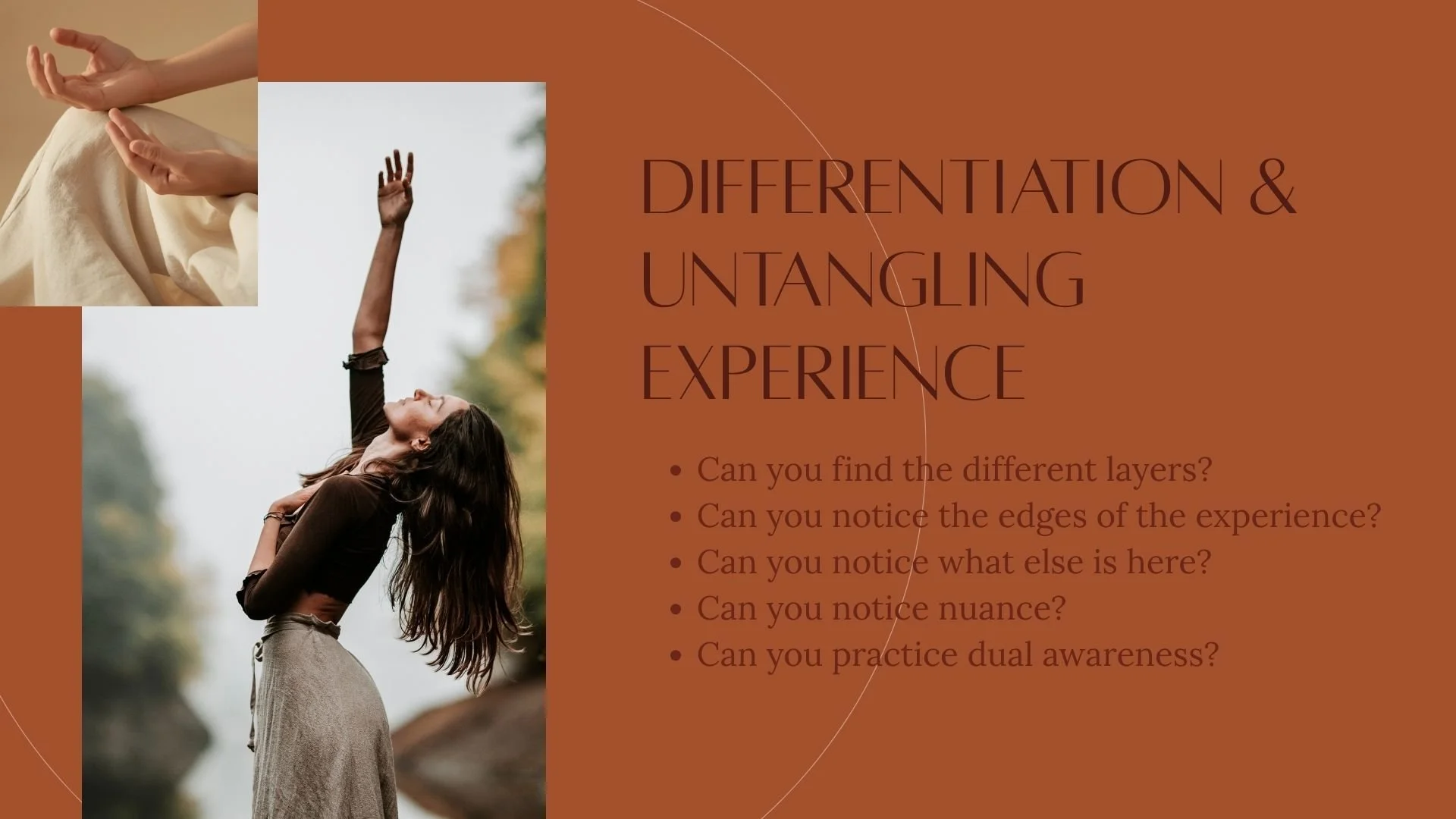
Differentiation
Untangling
Charged experiences usually arrive as one overwhelming mess of sensation, emotion, and story all at once, which is part of what makes them feel unmanageable. Separating this experience into single threads makes each piece small enough to actually hold.
Take one charged experience and notice it through only one channel at a time: first just the sensation, with no story attached, then just an emotion word, with no body detail, then just the thought or narrative, with no body detail. Notice how much lighter one untangled thread feels than the whole bundle of experience at once.
Time Slicing
A whole experience can feel too large to approach, but a small slice of it usually isn't. Breaking it into a timeline gives you a natural, smaller entry point.
Break the experience into before, during, and after, and choose to work with only the smallest slice first, rather than the whole thing. Questions that may support differentiation of the experience are:
How did the day start?
When did you know the hard part was over?
When did you know you were safe?
What was the hardest part?
What support or resource was available?
How did that day end?
Then and Now
Activation often carries an implicit sense that the threat is happening right now, even when it isn't, which keeps the body in a state of heightened awareness even after the original event. Asking this question interrupts that confusion directly.
Ask yourself whether what you're noticing belongs to something from before, or whether it's actually happening right now, in this room. I often ask myself and the people I support, “where are you, when are you?” Be here, now, where your feet are.
Body Region
When something feels big, it can seem like it has taken over the whole body, even when that isn't true. Locating what's unaffected proves to the nervous system that it isn't globally flooded.
Ask where in the body this feeling is less intense or not present and let yourself notice range in experience. Can you find another location that is even less intense, or even neutral. Can you find a location in your body that feels neutral or even like nothing; some easy places to find this might be the tip of your nose, your pinky nail, your earlobes. If it feels unavailable to you bring your awareness out of your body and find something less intense or neutral around, you. Notice how both can be here; distress or discomfort within you, steadiness or even safety outside of you, even if it’s just for this moment.
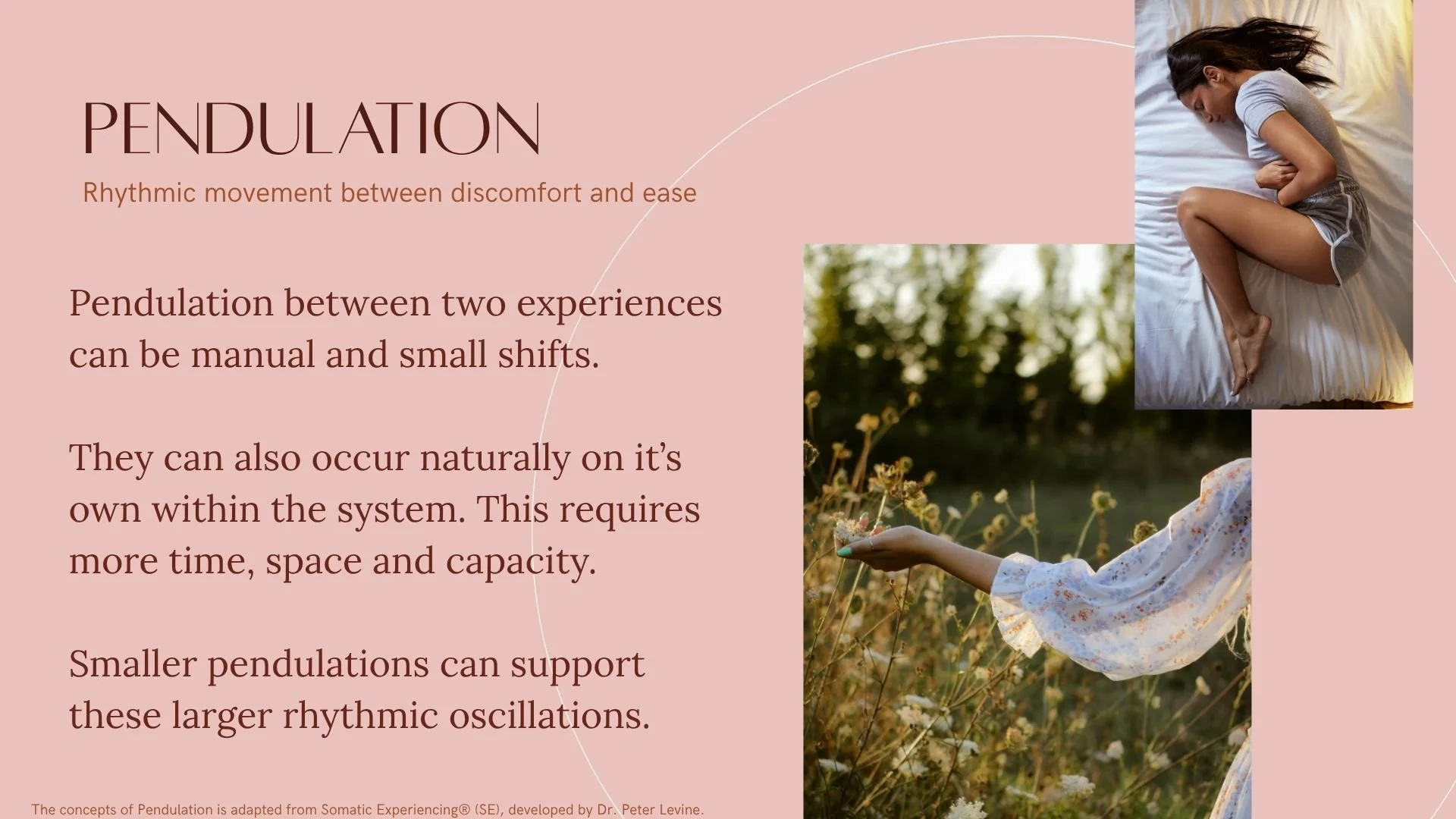
Pendulation
Timed exercise
Staying with one discomfort from list above intentionally for a set, known amount of time, and then deliberately taking a break, returning to a resource or support as needed, teaches the nervous system that activation doesn’t have to turn into a giant wave of overwhelm. Instead, we can surf that wave at a manageable wave of activation and then take a break until that activation has settled. Only once it’s settled, then you can try staying with the discomfort longer.
Setup
Remember, you're always in charge of your pace here. Stop, back off, or just observe if that's what's needed. Adjust time as needed.
Locate the point
Scan through your body and find one point of tension. It doesn't need to be big. Feel its edges, where it starts, where it ends. You're not changing it, just noticing its shape.
Round 1 (5 seconds)
Stay with it for 3-5 seconds. One… two… three. Now come back, hands, breath, the room. Notice if anything shifted, even slightly. No shift is also a valid answer.
Round 2 (10 seconds)
Find that point again, or a nearby one. Stay for 7-10 seconds. Come back, hands, breath, the room. What's different? What's the same?
Round 3 (15 seconds)
Same point, or wherever it's shown up now. Stay for 10-15 seconds. Come all the way back, feel your seat, your feet, the temperature of the room.
What you just practiced, moving toward discomfort in a timed dose, then deliberately returning to steadiness. This is pendulation on a small, manual scale. The larger pendulation, the one we're building toward with time and practice and support, is staying with an experience until it shifts, settles, or transforms on its own, within your capacity. You'll know something is outside capacity if overwhelm shows up, that tends to shrink capacity a little, because the system was asked for more than it could integrate. Pace of safety is the goal, but it isn't always guaranteed, and missing the mark sometimes is expected, not a failure.
The Internal Swing
This exercise brings your body back into balance by gently swinging your attention between a tight spot and a comfortable spot. First, find a place in your body that feels tense, like a clenched jaw or a heavy chest, and notice it for just a moment. Then, deliberately move your focus away from the tension and find a spot that feels relaxed, safe, or totally neutral, like your feet resting flat on the floor. Keep swinging your attention back and forth between the tight spot and the comfy spot every few seconds, letting the relaxed area naturally melt the tension away.
The Horizon Shift
This practice helps you be with or release stress by looping your attention between an internal worry and the big world outside. Start by noticing an anxious feeling inside your body, like a butterfly flutter or a knot of panic in your stomach, for just a couple of seconds. Next, look out a window or across the room at the farthest point you can see, letting your eyes relax and your chest open up. By alternating your gaze between the tight feeling inside and the wide-open space outside, you create a soothing rhythm that signals to your brain that you are safe.
The concept of Pendulation is from Somatic Experiencing® (SE), developed by Dr. Peter Levine.
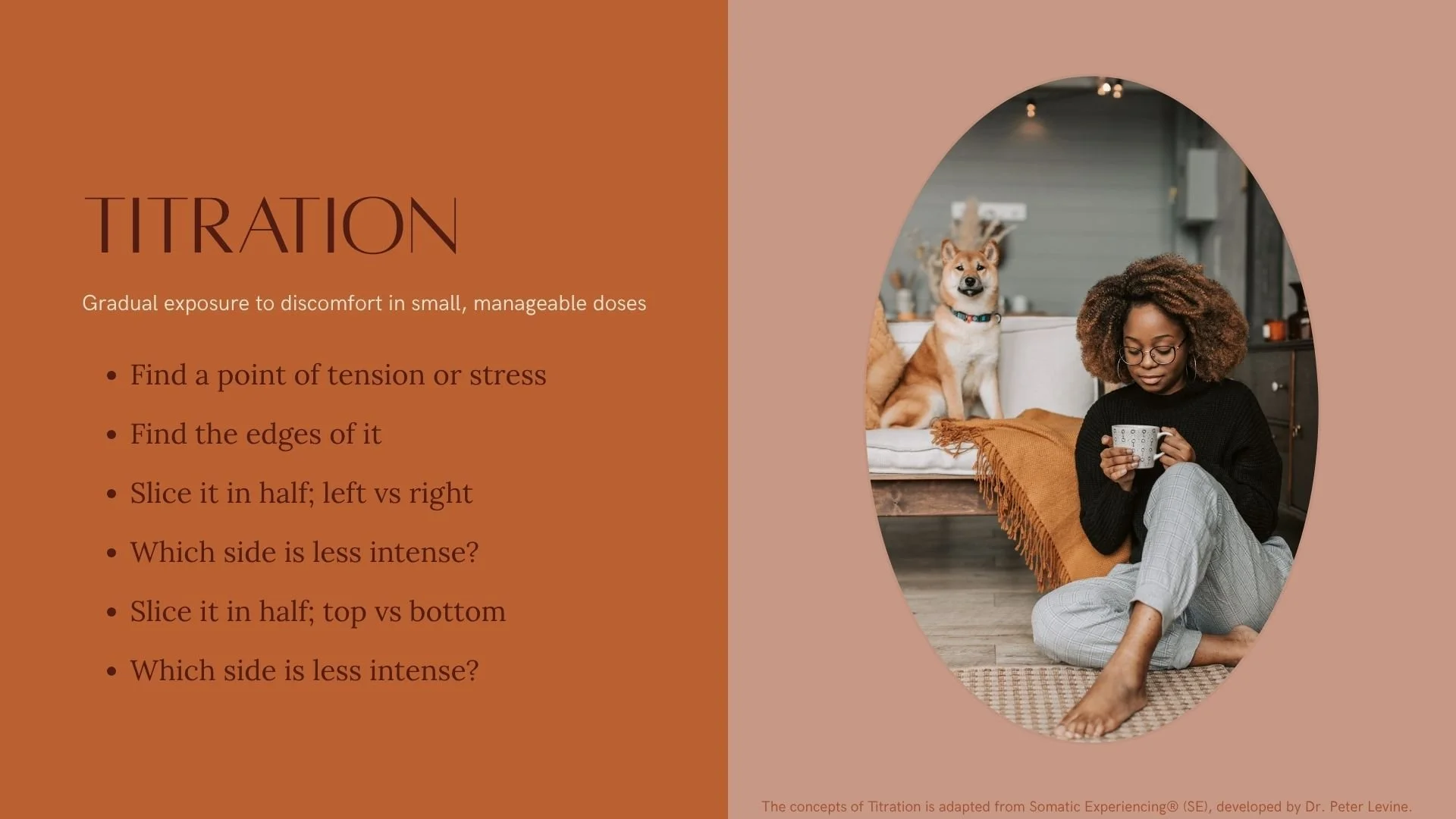
Titration
Boundary walk with a partner
Boundaries are often experienced abstractly, as an idea rather than a felt body signal. Practicing a physical version makes the moment of enough concrete and recognizable, so it can be trusted later in real situations.
Direct your partner to walk slowly toward you while you stay still. Have them stop the moment you notice anything shift in your body, whether that's a held breath, a brace, or a subtle recoil. Allow time and space for whatever came up to settle. When you’re ready have your partner walk towards you slowly again, only after you direct them to. Repeat and switch positions.
Micro movements
When the body is in freeze, even the idea of movement can feel impossible or unsafe. A movement too small to threaten that state proves to the system that movement is still possible at all.
Move something very small and low stakes, like a single finger or an eyelid, and notice that this is still allowed.
Next small yes
Big leaps toward something desired can feel disproportionately risky when capacity is limited, which often stalls action altogether. Finding the smallest possible movement keeps forward motion available even in a low-capacity moment.
Rather than aiming for the full yes, ask yourself what the smallest possible step toward yes would look like, and take only that step. For example, sending a dreaded email may begin with:
Look towards and away from the laptop
Touch the laptop and take a break
Turn on the laptop and walk away
Open your email and stop
Open a blank email to compose and rest
Type in just one word, or one sentence, or one email
Continue slowly with breaks and time and space to allow things to settle
The Drop by Drop Method
This exercise helps you handle big, scary feelings by touching into them in tiny, bite-sized pieces.
Start by bringing a small worry or stressful memory to mind, choosing something that only brings up a little bit of discomfort. Notice where you feel that stress in your body, look at it for just five seconds, and then quickly open your eyes, look around the room, and let the thought go. If it is hard to let go try again with something that creates less activation. The goal is to practice titration, although you’re also practicing pendulation, tracking and moving awareness. If it is still too challenging introduce sensory information that is stronger that you are able to pendulate to, some options:
Go walk outside slowly, look around with curiosity, imagine you are six years old seeing this environment for the first time
Hold a piece of ice or something warm in your hand
Taste something with a strong flavor
By taking in just a tiny drop of the stress and immediately stepping away, you teach your body that you can face hard things without panicking.
Slicing the Sensation
This practice helps you break a large, overwhelming body feeling into smaller, less scary pieces. When a big wave of anxiety or tightness hits you, don't look at the whole feeling at once. Instead, pick one tiny spot, like the very outer edge of your tight chest, and focus only on that small patch.
Ask yourself simple questions about it: Is it hot or cold? Is it sharp or heavy? Shrinking your focus to just one small slice makes the giant feeling lose its power and become much easier to handle.
You can also try literally slicing the area of sensation in half; left side vs right side. Locate the side that feels less intense, notice what happens as you simply recognize there is a part of the experience that is less intense. You can then slice the side that was less intense in half again; top vs bottom. You’ll end this exercise with the part that is the least intense.
The concept of Titration is from Somatic Experiencing® (SE), developed by Dr. Peter Levine.
Additional Tools
Physiological Sigh
Take two inhales through your nose, a short second inhale stacked right on top of the first, then let out one long, slow exhale through your mouth. This pattern can shift your nervous system toward calm faster and more reliably than a single normal breath. You can use it anywhere, anytime, and no one around you needs to know you're doing it.
Soothing and Containing Touch
Offer yourself touch that gives you pressure, warmth, or containment, so your body can register that it's held rather than exposed. Try each of these and notice which one your body prefers right now, since that can shift day to day.
Butterfly hug — cross your arms over your chest, resting your hands on your opposite shoulders or upper arms, then tap gently, alternating left, right, left, right.
Proprioceptive touch — press firm, steady pressure into your body, such as pressing your palms into your thighs or squeezing along your arms. This deeper pressure tends to feel organizing and grounding.
Skin grazing — use a much lighter touch, such as trailing your fingertips gently along your forearm or hand. This can be soothing in a different way than pressure.
Giving Energy Somewhere to Go
Activation that has nowhere to go tends to circle instead of resolve. This section is about giving mobilized energy an actual outlet, so it can complete rather than stay stored in the body. These tools pair naturally with fight and flight in particular, but any of them can be used any time something feels like it's built up with nowhere to release.
Wall Push
Place both hands flat against a wall and push, using real, sustained effort, as if you're trying to move the wall itself. Stay with it until your arms feel done, not exhausted, then release and notice what's different.
Hand Press
With a partner, you can press hadns as a way to express tension like annoyance or anger. It can also be a way to allow your body to express resistance or rejection. Begin with your partner bracing their stance, front leg slightly bent and back leg anchored behind them to be able to anchor themselves.press your palms against theirs and push, matching resistance so neither of you moves. This gives a mobilized push impulse a real target to meet, rather than letting it stay unexpressed.
Pillow Squeeze
Hold a pillow or cushion against your chest and squeeze it as hard as you want, using your whole upper body. Let the squeeze build and then release fully, rather than holding it at a constant low level.
Pounding
Pound your fists into a cushion, mattress, or the floor, letting the movement be as big or as small as feels right. This is especially useful when fight energy has built up with no clear direction to go.
Towel Twisting
Hold a towel with both hands and twist it in opposite directions, like wringing out water, using real force. The twisting motion mimics a wringing out of built up tension and gives the hands and forearms something concrete to do with the charge.
Titrated Shake Out
Shake out your hands, then your forearms, then your legs, in small doses, pausing back to stillness between each area. This mimics the natural discharge response seen in the body after a threat passes.
Voice and Sound Discharge
Let a sigh, a hum, a growl, or a tone come out on your exhale, whatever sound wants to happen, without shaping or performing it. The voice is often the discharge channel that's been kept quiet and letting it out here gives the activation one more place to go.
Reaching Exercise
This exercise lets you practice receiving something good, in the body, not just in thought.
Visualize one thing you want, hope for, or would like to offer yourself in this moment. It doesn't need to be realistic, it only needs to be desired.
Once you've landed on rich, vivid imagery of your desire, reach for it slowly. Allow your hands to cup it, keeping your arms outstretched, and feel it steady in your grasp.
Then slowly bring your hands back in toward you, visualizing this coming closer to you as an offering to yourself.
Make soft contact with your heart, or with whichever part of the body you want this to land in. In this moment, you are offering yourself what you desire. Even if you can only have it in the realm of visualization, your nervous system may still receive it as real.
The 5 R's
Resource
This is your Matrix of Support in practice, getting to know what actually resonates for your nervous system as a resource. Not every resource works for every person, so part of this R is discovery, noticing which safe place, which supportive figure, which anchor genuinely shifts something for you, rather than assuming it should.
Ritual
Regularly scheduled positive or neutral experiences that you weave into your daily life, on purpose. Stretching outside for a few minutes, slowing down to actually enjoy your coffee, listening to the same song during a particular part of your day. These aren't grand gestures, they're small, repeated moments of goodness or neutrality that the nervous system comes to expect and rely on.
Repetition
Repeatedly exposing yourself to titrated amounts of stress, within your capacity, on purpose. This is really tapping into repetition suppression, the way the nervous system's response to something lessens the more familiar and predictable that exposure becomes. Repetition is what turns a one time coping attempt into an actual skill.
Responsiveness
Making a real choice about where to go next, rather than defaulting to autopilot. This might mean pausing, bringing in a resource, tracking what's actually happening in your body, and then responding from there, rather than reacting before you've noticed anything at all.
Root
Really noticing. Going deeper into whatever shift just happened, not rushing past it. This is grounding, yes, but it's also attention, your brain can't learn what it isn't slowing down to notice. Rooting is what makes a small internal shift count as information your system can actually use later, instead of something that happened and was immediately forgotten.
RAIN
Recognize
Naming what's actually here, without judging it or trying to change it yet. This is the difference between being swept up in an experience and knowing you're having one. Even a simple, silent label, this is anger, this is tightness, this is fear, creates a small amount of distance between you and the experience, enough that you're no longer fused with it.
Allow
Letting whatever was recognized be there, rather than pushing it away, minimizing it, or rushing to fix it. Allowing doesn't mean agreeing with it, wanting it, or believing it should stay forever, it only means you've stopped fighting its presence in this moment. Most of what makes an experience feel unbearable isn't the experience itself, it's the resistance to it, so this step alone often reduces intensity before anything else changes.
Inquire
Getting curious about the experience with gentle, specific questions, where it lives in the body, what it needs, what it's connected to, how long it's been here. Inquiry treats the experience as something with information to offer, rather than a problem to eliminate as quickly as possible. This is active curiosity, not passive waiting, you're asking real questions and staying open to answers that might surprise you.
Nurture
Offering care to whatever was found, a kind word, a hand on the heart, a moment of simply staying present with it rather than moving on right away. This is the step that turns awareness into something restorative. Recognizing and allowing tell your system what's true, nurturing tells your system it's not alone with what's true, and that difference is often what actually creates change, not just insight.
Bringing it Back to the Nervous System
By now you've practiced each of these tools on their own, moving awareness, tracking, differentiation, pendulation, and titration. This section brings them together in one place, mapped onto the nervous system states they're most suited to support. You don't need to memorize this as new material. Instead, use it as a reference: when you notice yourself in fight, flight, freeze, fawn, or shutdown, come back here and see which of the tools you already know is the right one to reach for in that moment.
Review
Sympathetic. Mobilization. Heart rate rises, breath quickens and shallows, blood moves to the limbs, energy redirects away from digestion and connection and toward action.
Parasympathetic has two very different branches:
Ventral vagal. Safety and connection. Slower heart rate, easy breath, open posture, capacity to think clearly and engage with others.
Dorsal vagal. Conservation and shutdown, the oldest branch. Triggered by whether the system concludes that fighting or fleeing won't work, whether escape is genuinely unavailable, or has been learned to be unavailable.
Fight
Sympathetic, mobilized outward toward confronting a threat. Shows up as irritability, a controlling impulse, the urge to push back or attack.
Reach for the tools you already know:
The boundary walk, to register a limit before it turns into pushing back
Voice and sound discharge, letting a growl or firm exhale carry the charge
A titrated shake out through the arms, giving the mobilized energy somewhere to go
Pushing a wall
Flight
Sympathetic, mobilized toward escape. Shows up as anxiety, panic, restlessness, or compulsive busyness.
Reach for the tools you already know:
Exit orientation, from moving awareness, to answer the "can I get out" question directly
Titrated shake out through the legs
The 3, 7, 10 exercise, to practice staying briefly instead of bolting
Freeze
A blended state, sympathetic mobilization paired with dorsal immobility. The body is activated and braced, but movement is blocked. Shows up as feeling stuck, unable to speak or move, dread with nowhere to discharge it.
Reach for the tools you already know:
Micro movements, a single finger or an eyelid, to prove movement is still possible
Next small yes, from titration, the smallest possible step rather than the full response
Room scan and orientation, to re-establish that the present moment isn't the frozen one
Fawn
Not part of the original three state model, but a widely used clinical addition describing appeasement or compliance used to de-escalate a perceived threat. Shows up as people pleasing, loss of one's own needs, quiet resentment, difficulty saying no.
Reach for the tools you already know:
Yes/No practice, to rebuild the felt difference between the two
Self/Other differentiation, sorting what's actually yours from what you've absorbed from someone else
Next small yes, applied here as practicing the smallest possible no instead
Shutdown, Collapse
Dorsal vagal. The system concludes that both fighting and fleeing are unavailable. Shows up as numbness, dissociation, depression, exhaustion, disconnection.
Reach for the tools you already know:
Self-holding and proprioceptive touch, from the closing tools
Orienting back out, a slow return to the room
The physiological sigh, to gently re-engage the system
Warmth and slow pacing, nothing activating until some ventral tone returns
Ending at the Beginning, The Brain
The Introduction began with predictive processing, the brain's role in all of this. We close here the same way, because everything you just practiced in your body was never separate from that.
Your nervous system is constantly predicting what's about to happen, based on everything it has learned before, and acting on that prediction, often before you're consciously aware of it. This running prediction comes out of your generative model of reality; the internal picture your brain uses to anticipate the world and prepare for it in advance.
Your body also has a limited budget of resources it's managing at all times, energy, attention, physiological resources, sometimes called your body budget. Familiar patterns, the same reaction, the same brace, the same shutdown, are efficient. They don't require learning or trying something new, so they're easy to automate. That's why old patterns keep showing up even when they no longer fit. Autopilot isn't a flaw, it's the system conserving its budget by reusing what already exists. This is why it's worth being mindful of what in your life is taking your energy or giving you energy. A low body budget makes a small stressor land harder.
This is where the skills in this workbook do their real work. Each time you slow down enough to orient, track, differentiate, pendulate, or titrate, you create a small gap between the automatic prediction and what's actually happening. When you notice tension settles instead of moving on to the next stressor, when you say no and nothing bad happens, you create a prediction error, a mismatch between what your brain expected and what occurred. These small errors are what let your generative model update. Without these errors, the same predictions keep repeating, and the same stress loop keeps cycling instead of closing.
What you repeat, you reinforce, and you become efficient at. Every time you choose the slower path, orienting instead of bracing, tracking instead of avoiding, titrating instead of flooding, you teach your system a new prediction, one small rep at a time. The brain predicts. The body holds the evidence.
And here at Soul y Sombra, we bring the tools to work with both.

Somatic Wisdom for All
Found this helpful? Share your thoughts below.
SLIDES