SOMATIC SUPPORT WORKSHOP COMPANION
STAYING CONNECTED
TO SELF
Somatic support
for presence, play and every day.

This companion page is here to help you integrate the content explored during the workshop you attended where somatic psychoeducation was offered. Please remember to reflect and practice at the pace that feels right for you. The tools referenced below were developed by Peter Levine who founded Somatic Experiencing. Slides are available at the bottom of this webpage to further support the integration of this material. If you find this information helpful, please leave a review and explore our other offerings.
Thank you!
Melizza

“Awareness reveals the adaption, and that creates agency.”
Autonomic Nervous System
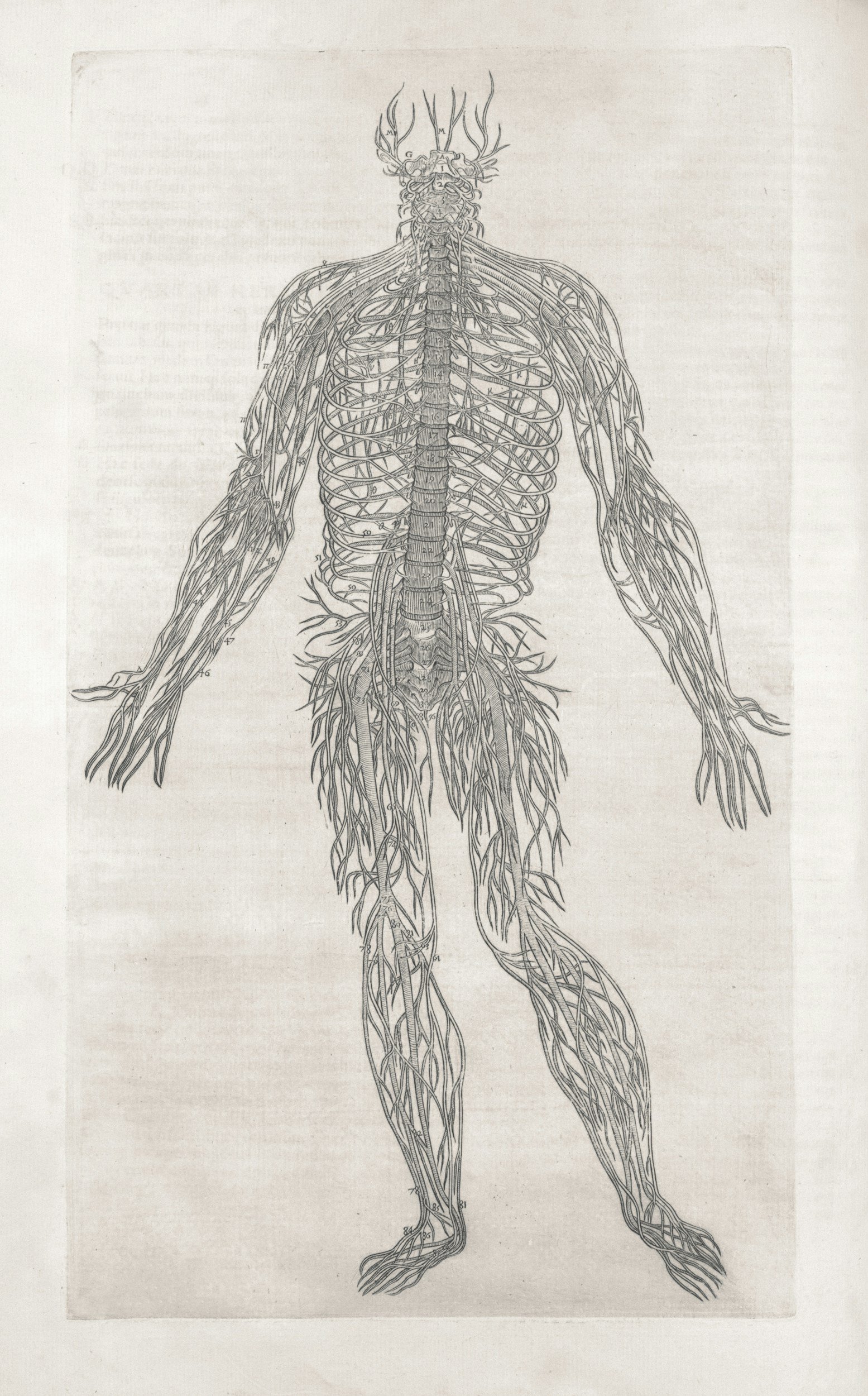
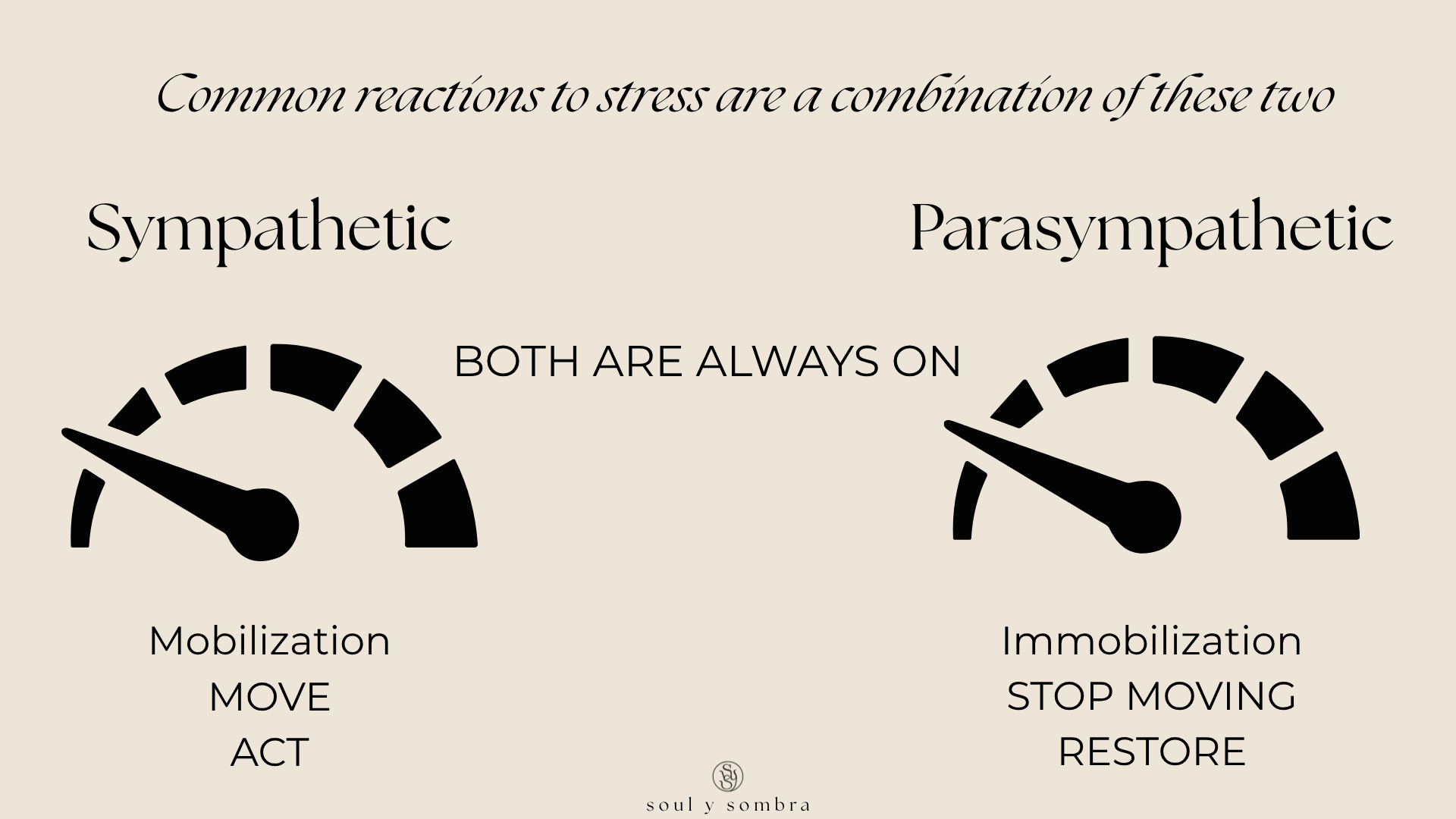
The autonomic nervous system helps regulate automatic functions like heart rate and digestion. Polyvagal theory offers a framework for noticing three common patterns. Ventral vagal is associated with feeling present, settled, and connected. Sympathetic activation prepares us for action and can feel like alertness, energy, or agitation. Dorsal vagal is associated with slowing down or shutting down, which can feel like heaviness, numbness, or disconnection. These shifts often happen automatically. Noticing them can help us recognize what kind of support we need. Under stress, these shifts can show up as protective responses such as fight, flight, freeze, fawn, or shutdown.
-
What It Feels Like: Heat, tension, jaw/fists clenching, heart racing
What It Looks Like: Snapping, arguing, controlling, irritability, needing to fix or win -
What It Feels Like: Restlessness, racing thoughts, tight chest, can't sit still
What It Looks Like: Overworking, avoiding, staying busy, leaving the room/conversation -
What It Feels Like: Numb, foggy, heavy, disconnected from body
What It Looks Like: Stuck, can't decide, can't start, going blank mid-task or mid-sentence -
What It Looks Like: Smiling, stomach drop, urge to smooth things over
What It Feels Like: “People-pleasing”, over-apologizing, agreeing before checking in with yourself, difficulty saying no, difficulty identifying or prioritizing needs and preferences
-
What It Feels Like: Flat, exhausted, far away, low energy
What It Looks Like: Withdrawing, disconnecting, going through the motions, hard to feel anything
Tracking & SIBAM

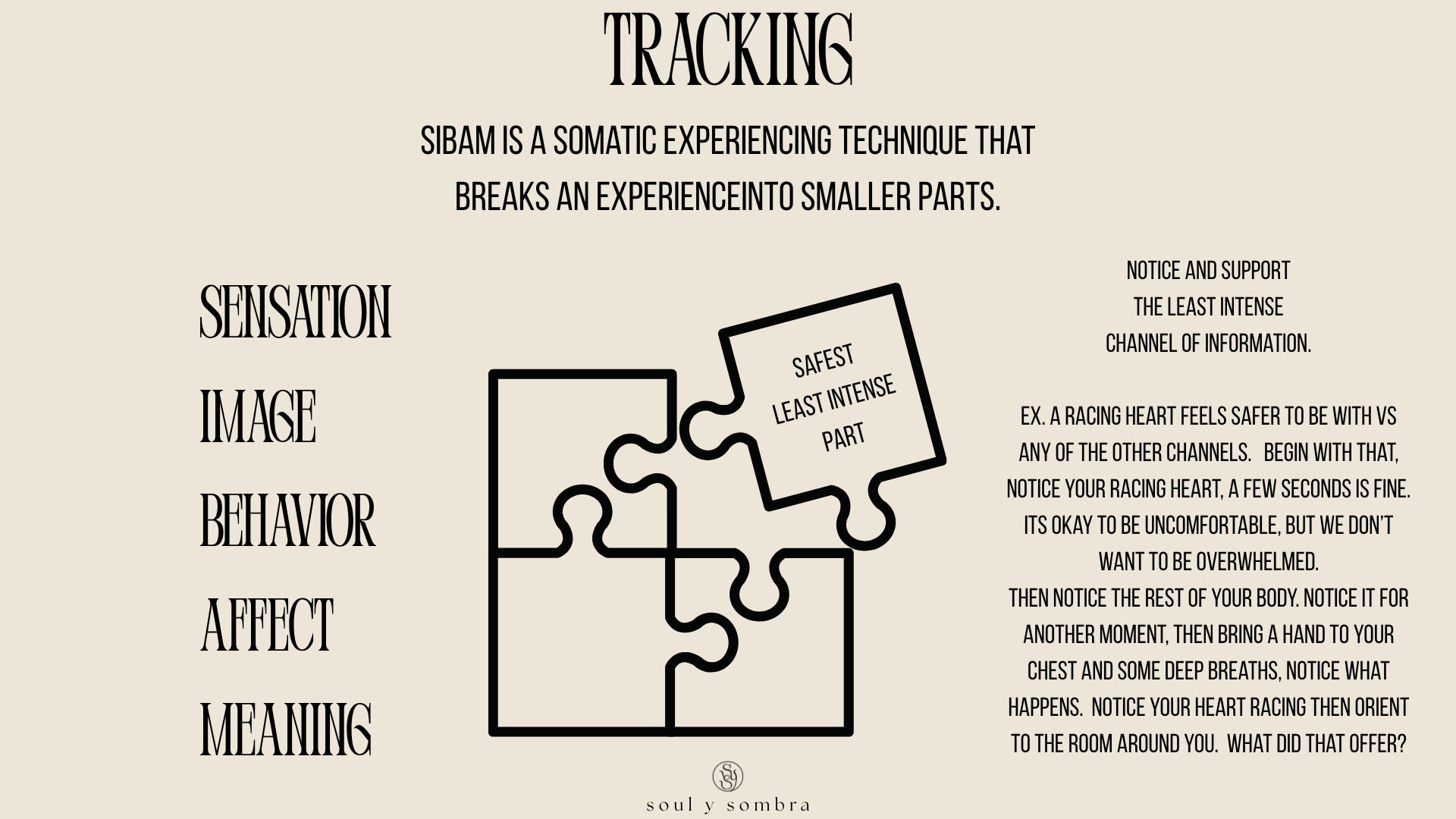
Tracking means noticing what shifts in our experience from moment to moment. Activation can come with stress or excitement, and settling might feel like an easier breath or a little less tension. SIBAM is a way to notice different channels of information; it gives us several ways to notice these shifts. With practice, we become more sensitive to early signs of stress and cues of safety, which helps us recognize when we need support and what kind of support might help.
-
What I feel in my body
Warmth, coolness, tingling, pressure, tightness, heaviness, lightness, fluttering, trembling, softening.
“My chest feels tight, and my hands feel warm.” -
What I see or what comes to mind visually like a color, a shape, a face, a snapshot, a familiar place, a scene from a memory, an imagined scene. “I see myself carrying around a giant boulder.”
-
What I do or feel an urge to do
Leaning in, pulling back, clenched fists, tears, looking away, smiling, reaching out, getting still, wanting to speak or leave. “I notice my shoulders up and an urge to take a step back.” -
What I feel emotionally; curiosity, excitement, joy, tenderness, relief, fear, irritation, sadness, embarrassment, unease.
“I feel curious and a little nervous.” -
What I tell myself about what’s happening like, “I’m okay.” “This feels familiar.” “I need more space.” “I don’t want to disappoint them.” “I can take my time.” Memories might also show up here too.
Foundational Somatic Tools

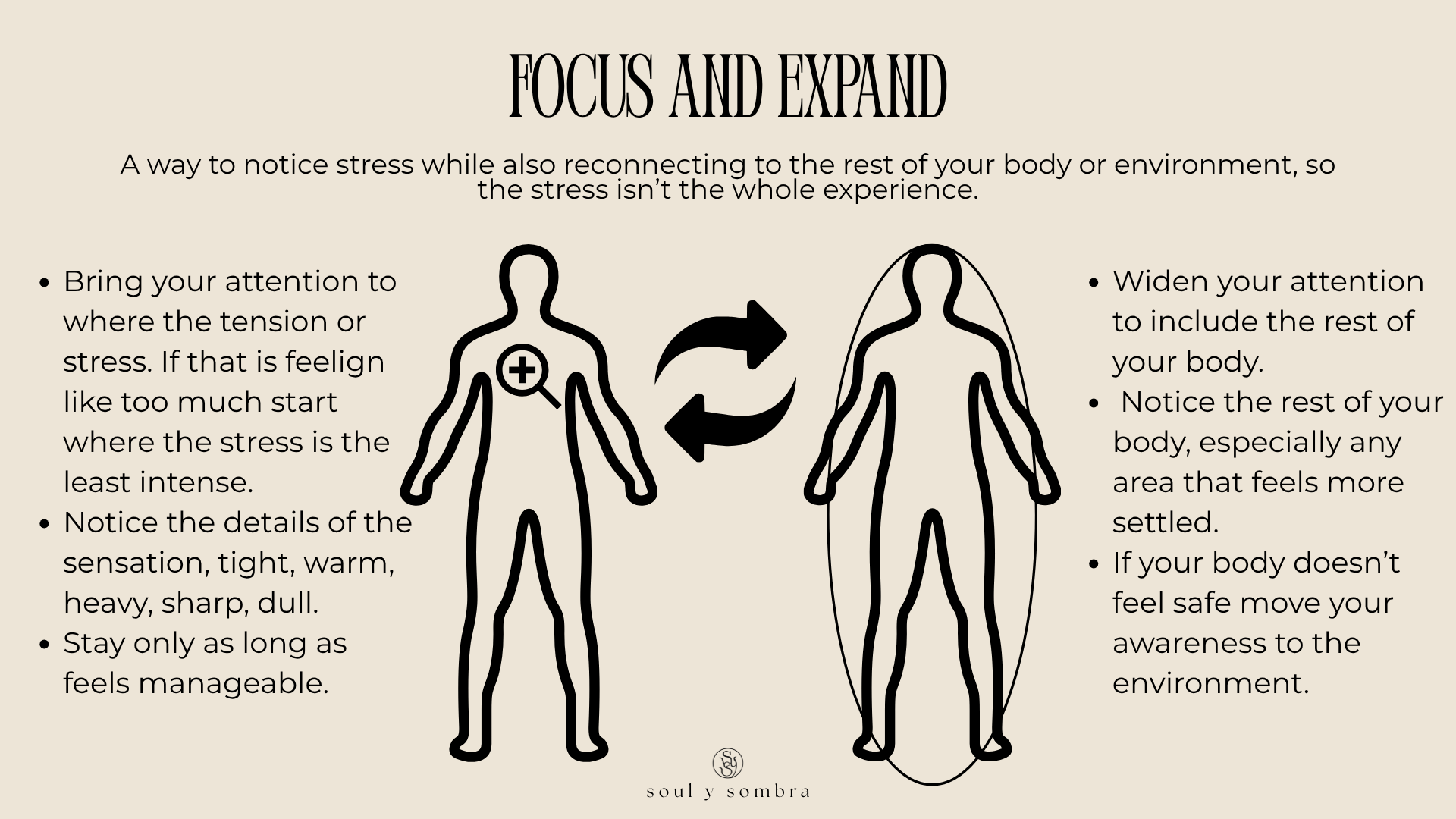
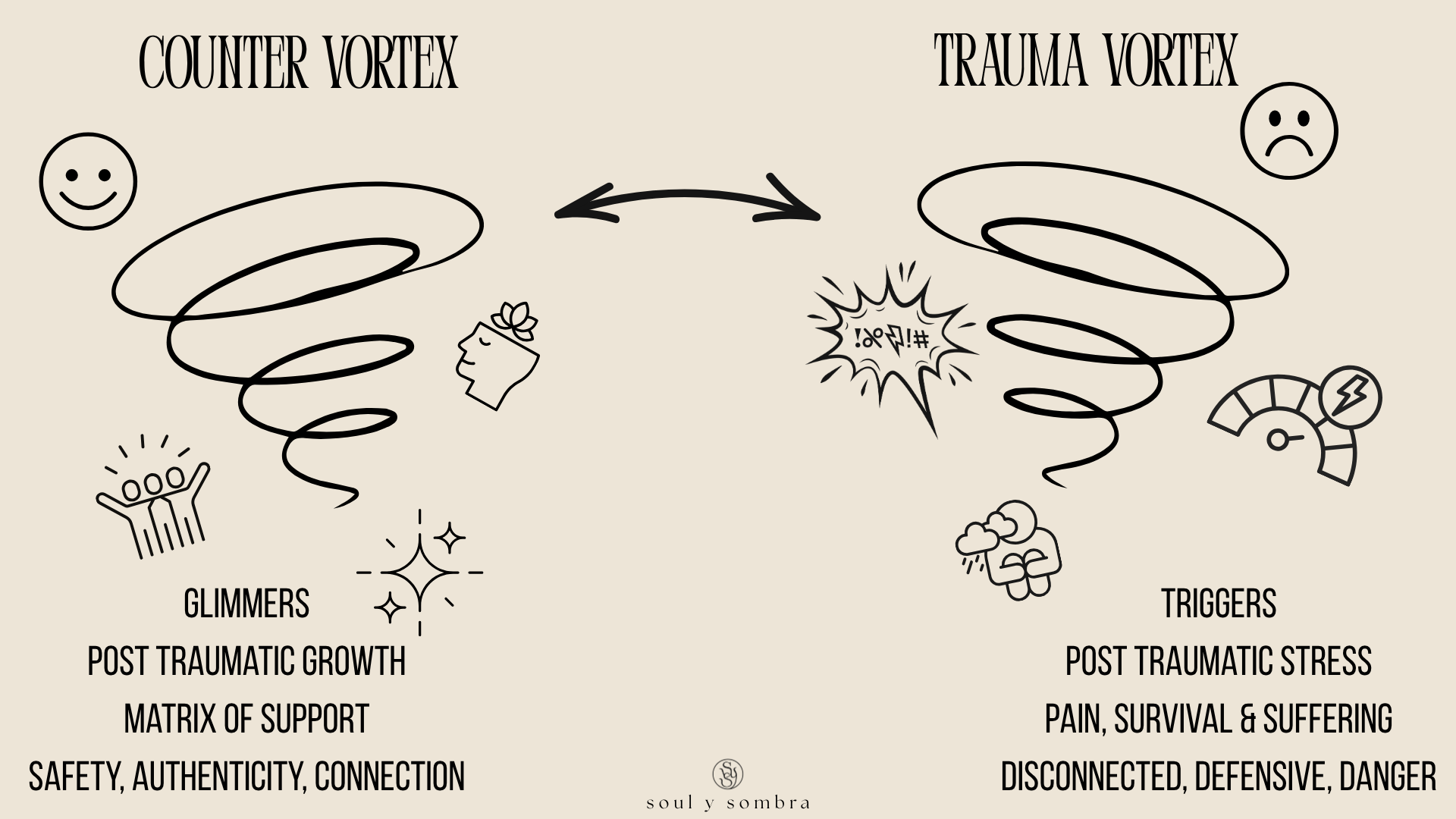
Foundational somatic tools help us notice when we need support and choose what might help. Tracking helps us catch early signs of stress or settling, while differentiation helps us get specific, like noticing that the jaw is tense while the shoulders feel at ease. When attention gets stuck on one sensation or thought, moving awareness can help us notice something else in the body or the room. In Somatic Experiencing, the trauma vortex describes the pull toward growing distress, and the counter vortex describes the pull toward steadiness, connection, or ease. Pendulation lets us move between a manageable bit of discomfort and something steadier, so there’s room to notice both. When an experience starts to feel like too much, titration means taking it in smaller amounts, with enough time to pause and decide what feels manageable next.
-
The trauma vortex is the pull toward the hard, activating material: the memories, sensations, and stories that spiral you further into distress. The counter vortex is the pull toward resource, ease, and safety. Naming which vortex you're in helps you recognize you have a choice about where to rest your attention, rather than getting swept along automatically.
-
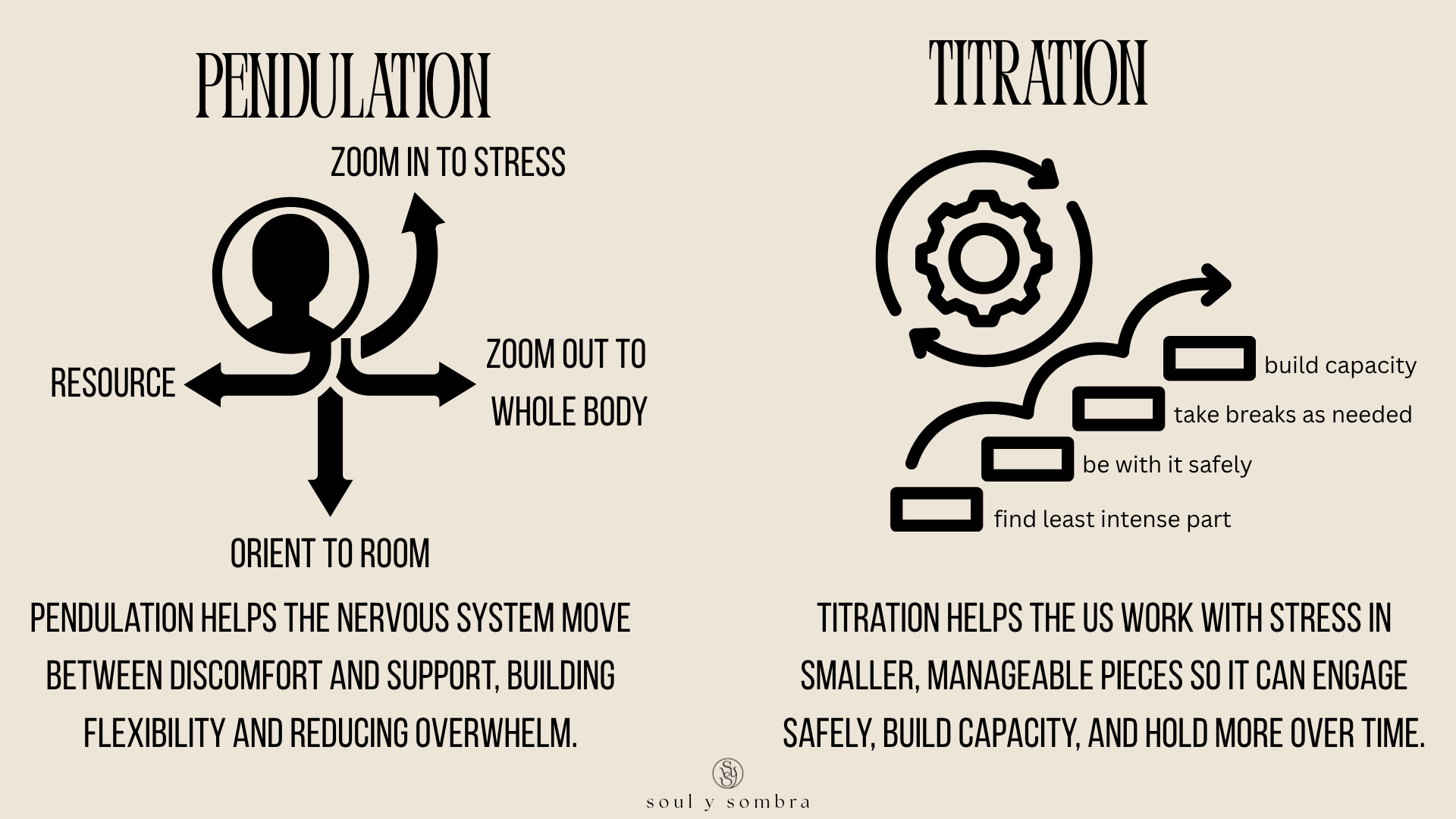
The rhythm of moving back and forth between stress and safety, contraction and expansion. You start with small pendulations, brief moments of noticing stress, then briefly returning to something steadier. Over time you build the capacity for bigger swings, staying with either state a little longer without getting stuck. This is how your system learns it can move through discomfort instead of being flooded or frozen by it.
-
Working with an experience in small, manageable doses instead of all at once. Just like adding a substance drop by drop rather than dumping it in, titration means approaching stress or activation in pieces your system can actually digest; a little sensation, a little pause, a little more. This supports you so you build tolerance without overwhelming your capacity. A way to do this in the body is to approach the “edges” of the experience. You can also map out where the activation is, split it in half, notice the side that feels easier to be with, you can even divide that side in half again, to make it more manageable.
-
Shifting your attention in and out of the body. Orienting to the environment is especially helpful to reconnect to the present moment, the environment and neutrality around you. It is also helpful to move your awareness between where there's intensity in your body and where there's none.
-
Noticing the small signals of activation, like a racing heart or feeling worried. And most importantly, it is helpful to notice settling or safety coming back online. Using SIBAM may also be helpful here (Sensation, Image, Behavior, Affect, Meaning) to guide what you're tracking. The goal is to become more familiar with our signals and more sensitive to noticing them.
-
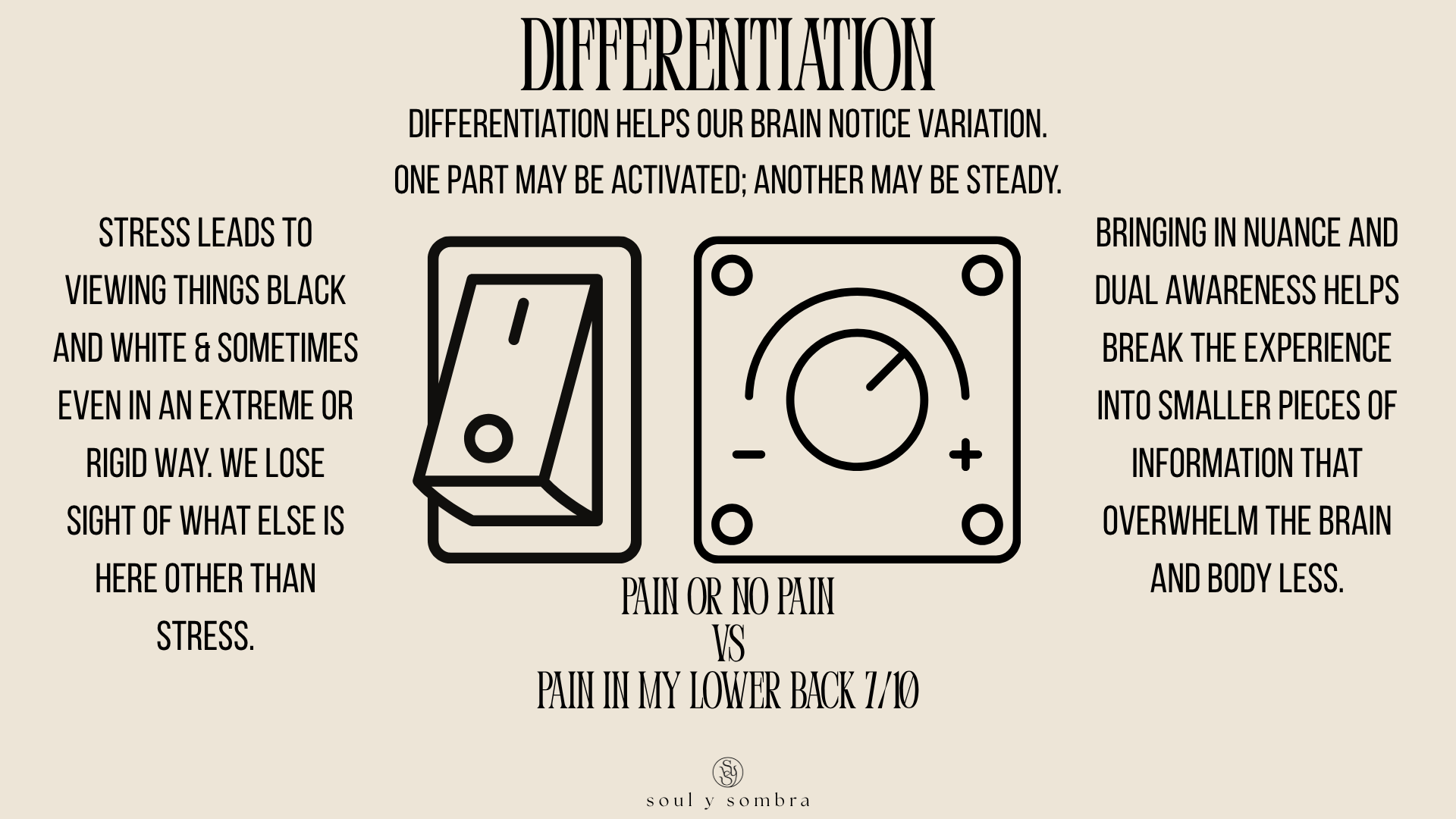
Recognizing that more than one thing can be true at once (dual awareness), and moving out of black-and-white thinking into the shades of grey in between. Rating your pain or discomfort on a scale, rather than treating it as all-or-nothing, can help you find that nuance. Noticing the edges of the stress or discomfort, "where does this lessen?", can also help your system not get stuck on high intensity. The goal with differentiation is to be able to give your nervous system more information. For example, “I’m angry”, turns into I feel heat in my belly and it is a 6/10 but I don’t feel it in my chest.
Visual Resources

A visual resource is an image that helps us reconnect with a sense of steadiness, support, or feel soothed. People have drawn on imagery in some of the most demanding situations, from Olympic competition to military operations. For practices like the safe place or container, start with an image that resonates personally, then make it vivid. Notice the colors, the quality of the light, the textures, and any sounds that go with it. The details help bring the image to life, and its personal meaning helps it feel like something we can draw on when we need support.
-
Bring to mind a real or imagined place where it feels possible to settle a little. It might be a quiet corner, a garden, or somewhere entirely imagined. Comfortable enough is enough.
Make it vivid. Notice the light, colors, temperature, and sounds. Imagine the texture of something nearby or the support of the ground beneath you.
Stay with one detail that feels especially supportive. Notice what shifts, if anything. When ready, bring your attention back to the room.
You can bring your present self, wounded parts, or your younger self here.
-
Imagine a container that feels sturdy and easy to close. It might be a jewelry box, chest, a cabinet, or a storage unit. Picture its size, material, and how it opens. Add a lock and your name to it so it feels secure and personalized.
Choose a thought, image, sensation, emotion or task that you would like to put down. Give it a form and imagine placing it inside. There’s no need to go through the details.
Close the container and lock it. Remind yourself, “I can come back to this when I have more time or support.” Look around and notice what’s here now.
-
Choose the kind of support that would help right now. A figure can be real, imagined, or symbolic. One figure can offer several kinds of support.
Nurture: Someone who offers warmth and care. Imagine their voice, expression, or the way they sit beside you.
Wisdom: Someone whose perspective helps you see more clearly. Imagine what they might say or what it feels like to have them listen.
Protection: Someone who respects your limits and helps create space. Imagine where they would stand or what they would do to support your boundary.
Picture the figure at a distance that feels right. Add details that make their presence feel recognizable. Notice what it’s like to receive that kind of support.
-
Choose an animal whose way of responding resonates with you. Picture a doe turning toward a sound, a fox slipping away, or a bear making its presence known.
Make the scene vivid. Notice the animal’s stance, gaze, breathing, and movement. Imagine how it responds to what’s happening. It might get still, create distance, stand its ground, or become fierce when it needs to protect itself.
Notice the quality that feels useful right now. Maybe it’s alertness, agility, strength, or permission to protect yourself without having to justify it. If it feels helpful, try a small movement that reflects that quality, like planting your feet or turning toward an exit.
-
Imagine a boundary around you. It could be a line on the floor, a garden gate, or a layer of light. Give it a color, shape, texture, and distance that feel right.
Adjust it. Move it closer or farther away. Make it firmer, softer, or easier to open and close. Notice what changes when you decide how much space you want.
Ask, “Does this image tell me something about what I need right now?” That might mean moving back, asking for more room, saying no, or ending an interaction. Let the image help you recognize the boundary you want to act on.
Exercises
These exercises help us notice smaller changes in our bodies, recognize what we want, and practice responding while there’s time and room to choose. Start in an everyday moment, use a practice to prepare for something coming up, or try a partner exercise with someone you trust or someone you’ll be working with. Practicing together can make it more familiar to ask for a pause, express a preference, or receive someone else’s boundary. A small shift is worth noticing. An easier breath, a little more clarity, or a clearer sense of “I want more space” can all help us recognize what support feels like.

-
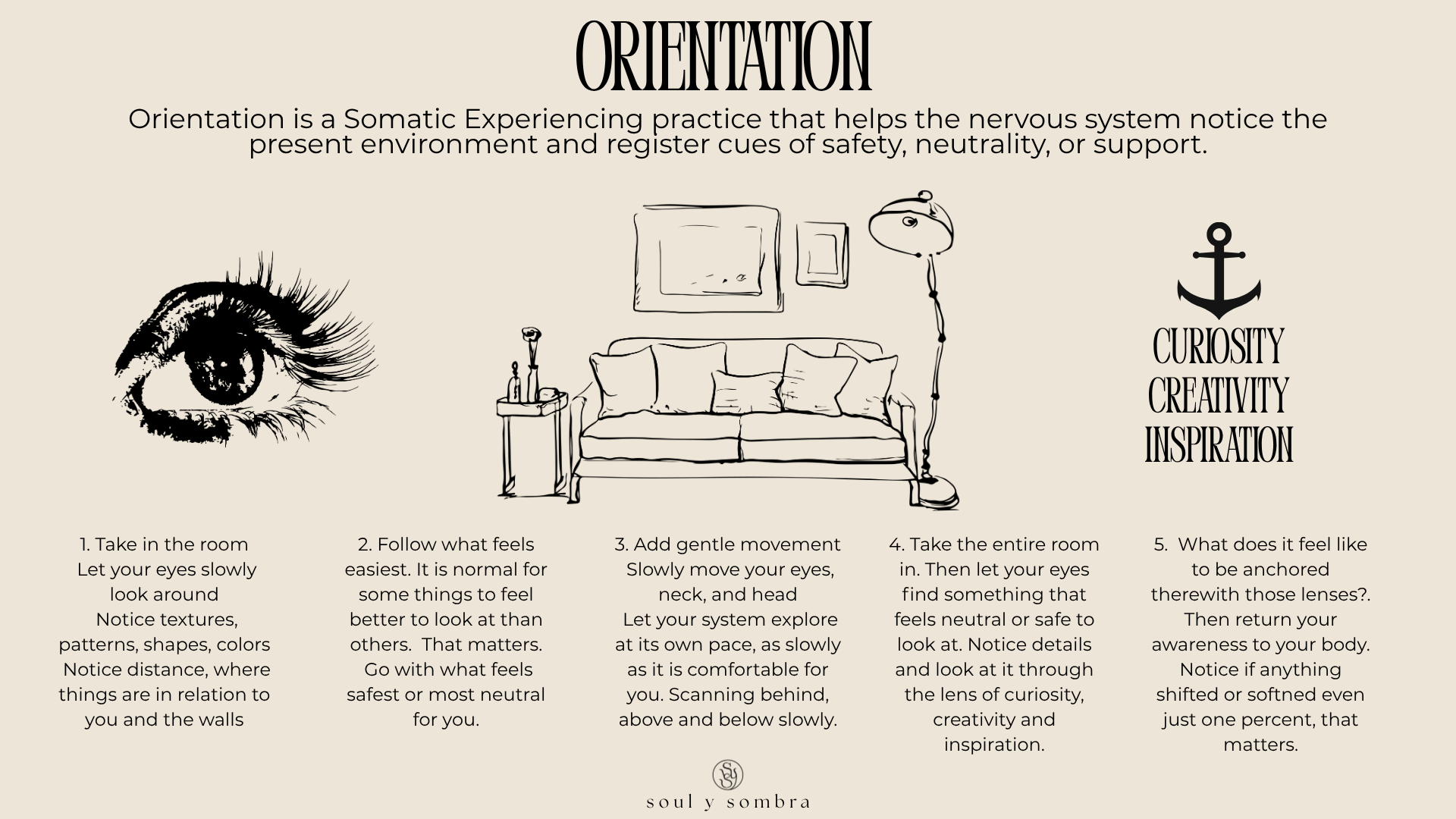
Take in the room. Let your eyes move slowly from side to side in gentle, horizontal sweeps. Notice colors, textures, patterns, shadows, and shapes. Let the edges of your visual field come into awareness as you look around.
Let your eyes land on something neutral. Look at it with curiosity. What detail have you never noticed before? Is there a shape, pattern, or play of light that invites a little imagination or inspiration?
Notice how the practice supported you. Bring your attention back to yourself. Maybe your breath feels a little easier, your attention feels less narrow, or you feel more here. Even if the shift is only 1%, spend a moment noticing and staying with that part of the experience. This is how we practice recognizing subtle signs of settling.
-
Choose a low-stakes question. With someone you trust, take turns asking something simple, like “Would you like to switch seats?” Agree to welcome both answers with the same warmth.
Pause, then answer. Notice what it’s like to say yes and what it’s like to say no. Take turns trying both. “Not yet” or “I’m not sure” can also be practiced.
Receive each answer enthusiastically and supportively. A yes might get, “Great, I’d love that.” A no might get, “Absolutely. I’m glad you told me.” Let the answer stand without persuasion, disappointment, or a request for an explanation.
Notice how it feels to be received. What changes when a no is welcomed as warmly as a yes? The practice gives both people a chance to experience honesty without rejection or judgment.
-
Start with space. One person stays in place and directs the pace. The other waits at a comfortable distance. Agree on a stop word or gesture and keep the exercise free of touch.
Wait for readiness. The person directing takes a moment to notice whether they’re ready for the other person to walk. When ready, invite one slow step closer.
Ask for a stop at the first sign of something. It might be excitement, confusion, awkwardness, curiosity, warmth, or a shift in attention. The approaching person stops right away. There’s no need to wait for discomfort.
Notice the feeling and give it time to settle. What happens when the movement stops and the request is respected? The feeling can stay, soften, or change. Then choose what happens next. Another step, more distance, staying still, and finishing are all options.
-
Choose one spot of tension. Pick an area that feels manageable to notice. Where is the tension? Does it feel tight, heavy, warm, or something else? Take a moment to notice how it feels before changing anything.
Slow the breath gently. Breathe in through the nose and imagine the inhale traveling toward the back of the skull. Allow the lower ribs and belly to move naturally. Let the exhale extend a little, as long as that feels comfortable. Take a few rounds, then check in with the spot.
Let the breath feel like a soothing touch. Imagine the inhale tenderly grazing the area upward, then the exhale brushing it downward. Try a few rounds. Pause and notice what happens.
Add an element. Choose an image that feels soothing to you. Fire might be warm sunrays, air a cool breeze, earth soft grass or a feather, and water a gentle bubbling stream. Imagine that element brushing upward with the inhale and downward with the exhale. After a few rounds, notice how the area feels.
Offer a message of compassion. Choose a phrase that feels right, like “I see you,” “I’m with you,” “Thank you,” or “I know.” Imagine sending the words toward that spot with the inhale and letting them settle a little deeper with the exhale. Notice what’s there now, whether the tension softened, stayed the same, or made another need clearer.
Keep the breath comfortable throughout. At any point, it’s okay to return to ordinary breathing and look around the room.


Somatic Wisdom for All
Found this helpful? Share your thoughts below.
SLIDES